

Scholarcy ⭐ Verified
What is Scholarcy?
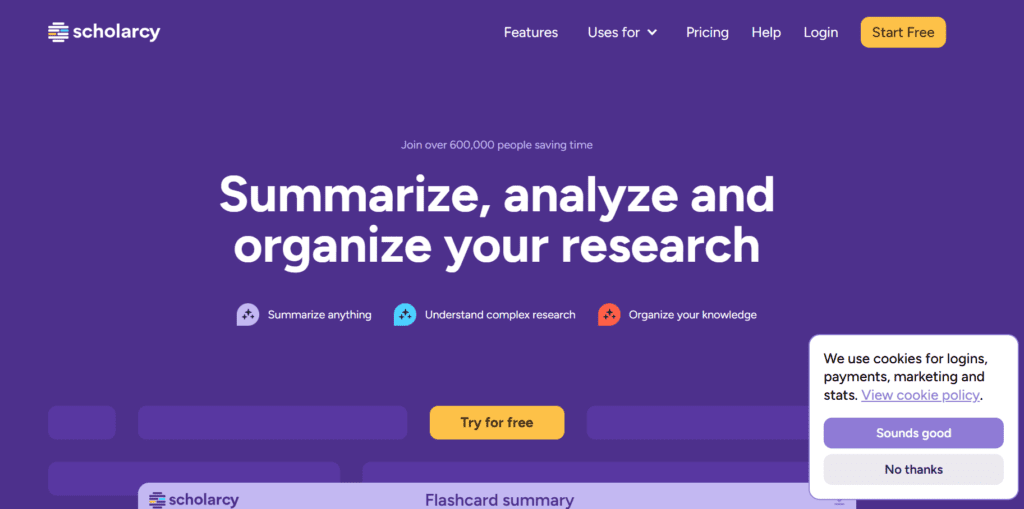
Scholarcy AI is an academic research summarization tool that converts long research papers, reports, and articles into structured summaries. Users can quickly understand complex academic material without having to read entire documents. The platform is based on natural language processing and machine-learning summarization models. These models identify research components such as methodology, results, references, and key findings and help Scholarcy to produce organized outputs. The AI stands out for its dense research into actionable learning materials, such as flashcards, highlights, and literature matrices. It is ideal for students, researchers, and professionals managing large volumes of academic content.
Review Summary
| Performance Score | A |
| Content Quality | Produces clear, research-focused summaries extracted from the research. |
| Interface | Clean and minimal interface designed for distraction-free reading. |
| Ai Technology | Uses NLP models optimized for scholarly document understanding. |
| Purpose | Built specifically for academic reading and literature review workflows. |
| Compatibility | Works across browsers and supports multiple document formats. |
| Pricing Summary | Affordable monthly plan with strong research-oriented features. |
Scholarcy Key Features
| 1 | AI-powered academic paper summarization |
| 2 | Interactive summary flashcards |
| 3 | Automatic reference and citation extraction |
| 4 | Literature matrix creation |
| 5 | Smart highlighting and note editing |
| 6 | One-click bibliography generation |
| 7 | Knowledge organization library |
Who is Best for Using Scholarcy?
Scholarcy AI is an academic research summarization tool that converts long research papers, reports, and articles into structured summaries.
Is Scholarcy Free?
Scholarcy offers a free plan with limited features. Paid plans start at $4.99/month
Pros & Cons
Pros
- Saves significant time when reviewing academic papers.
- Converts research into structured flashcards.
- Excellent for literature reviews and thesis.
- Supports multiple file formats.
- Built for academic workflows.
Cons
- The free plan has strict summary limitations.
- Complex PDFs may reduce summarization accuracy.
- Requires verification for citation precision.
- Limited usefulness outside academic content.
- Advanced features require a subscription.