

Stories On Board ⭐ Verified
What is Stories On Board?
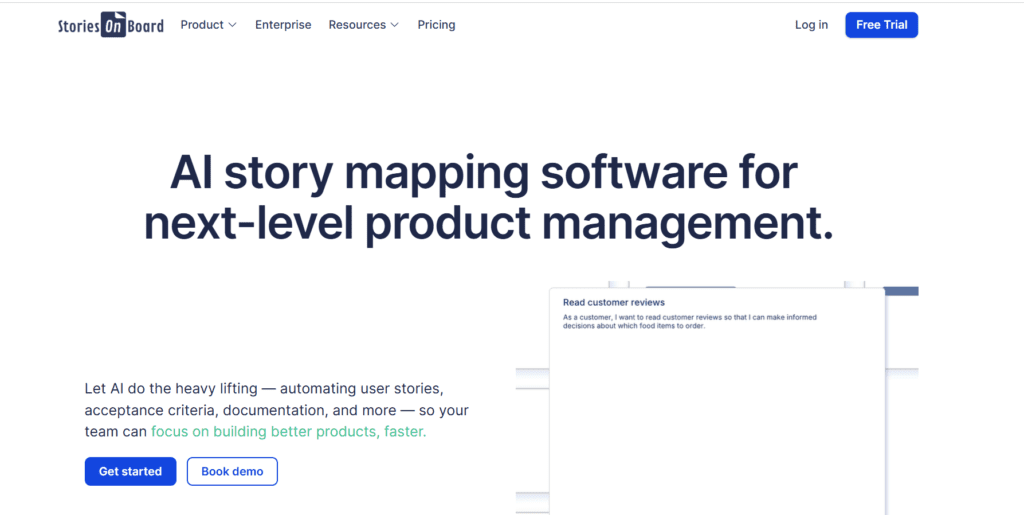
Stories On Board AI is a product management and user story mapping tool that helps agile teams plan, organize, and prioritize software development workflows. It enables teams to map user journeys visually. The platform uses AI assistance trained on product management and story-mapping best practices rather than a generic writing model. Its standout capability lies in combining visual collaboration with intelligent automation, allowing teams to brainstorm, prioritize, and release products faster. The tool is ideal for product managers, scrum teams, and development organizations.
Review Summary
| Performance Score | A |
| Content Quality | Produces structured and agile-ready documentation outputs. |
| Interface | Clean visual story-mapping interface suitable for teams. |
| Ai Technology | Context-aware AI trained for product and backlog workflows. |
| Purpose | Streamlines product planning and agile development processes. |
| Compatibility | Works with Jira, Azure DevOps, Trello, GitHub, and browsers. |
| Pricing Summary | Affordable tiered pricing with scalable AI token usage. |
Stories On Board Key Features
| 1 | AI user story generation |
| 2 | Visual story mapping boards |
| 3 | Product roadmap planning |
| 4 | Backlog prioritization frameworks |
| 5 | Release planning and summaries |
| 6 | Real-time collaboration tools |
| 7 | Idea and insight management |
| 8 | Jira, DevOps, Trello, and GitHub integrations |
| 9 | Custom AI functions and templates |
| 10 | Feedback and stakeholder portals |
Who is Best for Using Stories On Board?
Stories On Board AI is a product management and user story mapping tool that helps agile teams plan, organize, and prioritize software development workflows.
Is Stories On Board Free?
Stories On Board is a paid tool. Pricing starts at $11/Month
Pros & Cons
Pros
- Specialized AI built specifically for agile workflows.
- Visual story mapping improves planning clarity.
- Strong integrations with development tools.
- Collaborative environment for distributed teams.
- Automated documentation saves significant time.
Cons
- Learning curve for non-agile users.
- AI token limits vary by pricing tier.
- Advanced features are locked behind higher plans.
- Requires a structured setup for best results.
- Limited offline functionality.