AI tools for recruiters in 2026 automate sourcing, resume screening, video interviews, and hiring workflows. Today, 87% of companies use AI-driven recruiting systems to manage applicant volume and reduce time-to-hire. If you want to understand how AI is transforming hiring at the enterprise level, our guide on AI Tools for HR Professionals covers the full strategic picture.These platforms help recruiters process bulk candidate data faster while improving hiring accuracy and compliance.
These days, any recruiter posts a job, and a plethora of candidates apply. The result is bulk data that takes longer to analyse. The CEO, unaware of this burdensome task, asks you to hire quickly. But when you look at the data, you know your own job is now in danger.
Moreover, if you do fast, how can you ensure you have picked the best candidate for the role?
In this blog, you will learn about 15 AI Tools for recruiters in 2026, their working, categories, and the power of recruiting. Let’s end the best talent search hassle with AI on your side! For a broader look at how AI is reshaping workforce decisions, explore our guide on Best AI Tools across every category.
Quick Snapshot: Top AI Tools Types for Recruiters 2026
| Tool Type | Best For | Ideal Company Size |
| AI Talent Intelligence | Enterprise Hiring | Large Teams |
| Automated Sourcing Tool | Passive Candidates | SMBs |
| AI Screening Platform | Resume Parsing | All sizes |
| Video Interview AI | Interview Process Automation | Mid Enterprise |
| AI-Powered ATS | Full Recruiting Workflow | Startup Enterprise |
What Are AI Tools for Recruiters?
AI tools for recruiters are AI-powered systems that automate hiring processes, including automated sourcing, candidate screening, job description optimization, and video interview analysis. They help hiring managers improve hiring accuracy, reduce time-to-hire, and make data-backed hiring decisions.
AI recruiting software combines workflow automation with predictive artificial intelligence. Rather than manually screening resumes or filtering job applicants by hand, AI evaluates candidate information, prioritizes candidates by skills, and facilitates organized hiring procedures.
Modern talent acquisition teams use these tools to scale recruiting operations while maintaining consistency, compliance, and measurable performance outcomes.
AI-powered recruiting tool = automation + prediction
Automates repetitive recruiting processes while predicting candidate-job fit using structured candidate data.
Generation AI = job description & outreach drafting
Uses generative AI to create optimized job descriptions, candidate emails, and recruiter outreach aligned with search intent and role requirements.
AI-driven screening = skill-based filtering
Applies machine learning models to evaluate experience, competencies, and qualifications during candidate screening.
What Types of AI Recruiting Software Exist in 2026?
The types include automated sourcing platforms, AI candidate screening tools, video interview analysis systems, AI-powered applicant tracking systems, talent intelligence platforms, and job description optimization tools.
Each category supports a specific stage of the recruiting process and improves hiring efficiency. AI recruiting tools are structured around hiring workflow stages. Understanding the software type helps recruiters align automation with operational needs instead of adding disconnected tools.
Types of AI Recruiting Software
1. Automated Sourcing Tools
AI-driven platforms that identify and engage active and passive candidates using large talent databases, behavior signals, and matching algorithms.
Primary outcome: Faster candidate discovery and pipeline growth.
2. Candidate Screening AI
Machine learning systems that parse resumes, score candidates based on skills, and rank applicants according to job description alignment.
Primary outcome: Reduced manual resume review time.
3. Video Interview Software
AI-powered interview platforms that analyze structured video responses and support consistent evaluation across candidates.
Primary outcome: Standardized interview process and improved comparison accuracy.
4. AI-Powered Applicant Tracking Systems (ATS)
Applicant tracking systems enhanced with artificial intelligence for resume parsing, workflow automation, and predictive recommendations.
Primary outcome: Streamlined recruiting processes and centralized candidate data.
5. Talent Intelligence Platforms
Advanced AI systems that map workforce trends, skills gaps, and market data to support long-term talent acquisition planning.
Primary outcome: Data-driven hiring strategy.
6. Job Description Optimization Tools
Generative AI platforms that refine job descriptions for clarity, inclusivity, SEO visibility, and higher candidate conversion rates.
Primary outcome: Improved job post performance and better candidate fit.
How Did Our Experts Evaluate the Best AI Tools for Recruiters in 2026?
Experts at Daily AI Tools evaluate AI recruiting software based on automation depth, AI-driven matching accuracy, resume parsing quality, compliance readiness, integration flexibility, pricing transparency, and real-world recruiter usability.
Each platform is tested for scalability, bias mitigation controls, and performance across modern hiring workflows. Our expert review framework focused on measurable recruiting impact rather than marketing claims.
We analyzed how each AI recruiting tool performs across sourcing, screening, interview management, and applicant tracking system integration to ensure practical value for talent acquisition teams.
Evaluation Criteria
AI-Driven Matching Accuracy
We measured how effectively the tool matches candidates to job descriptions using skills-based filtering, contextual data, and predictive ranking models.
Impact: Improves hiring accuracy and reduces shortlisting errors.
Resume Parsing Quality
We tested structured resume parsing capabilities across formats to evaluate data extraction reliability and candidate profile completeness.
Impact: Reduces manual data correction and ATS friction.
Diversity Hiring Compliance
We reviewed bias-detection systems, anonymized screening features, and compliance safeguards aligned with fair-hiring regulations.
Impact: Supports equitable hiring decisions and regulatory protection.
Applicant Tracking System Integration
We assessed compatibility with leading applicant tracking systems, workflow automation strength, and data synchronization reliability.
Impact: Prevents workflow fragmentation and the creation of duplicate systems.
API Access
We evaluated the availability and flexibility of API access for enterprise integrations, reporting tools, and custom automation needs.
Impact: Enables scalable recruiting infrastructure.
Data Privacy Controls
We analyzed encryption standards, user permissions, compliance with global data protection frameworks, and candidate data governance.
Impact: Protects sensitive applicant information.
User Experience
We reviewed dashboard clarity, onboarding time, recruiter adoption rate, and overall usability during live recruiting scenarios.
Impact: Reduces learning curve and increases team efficiency.
List of 15 Best AI Tools for Recruiters in 2026
The best AI tools for recruiters in 2026 combine automated sourcing, AI-driven candidate screening, structured interview support, talent intelligence, and workflow automation. These platforms help hiring managers reduce time-to-hire, improve candidate matching accuracy, and scale recruiting operations efficiently.
The following is the expert-verified and reviewed list of 15 best AI tools for recruiters in 2026:
1. Eightfold AI
Eightfold AI is a talent intelligence platform that uses deep learning models to match candidates based on skills, career trajectories, and workforce data, rather than keywords alone.
Pro: Advanced skills-based matching powered by large-scale workforce datasets.
Con: Enterprise pricing may not suit smaller teams.
Limitation: Implementation and data configuration can require onboarding support.
Who is it for: Enterprise talent acquisition and global workforce planning teams.
Pricing: Custom enterprise pricing.
2. HireVue
HireVue is an AI-powered video interview platform that supports structured digital interviews, assessments, and workflow automation for high-volume hiring.
Pro: Scales structured interviews across large candidate pools.
Con: Past debates around AI scoring transparency.
Limitation: Best suited for standardized hiring models.
Who is it for: Large enterprises and high-volume recruiting teams.
Pricing: Custom pricing. Reach out for sales department
3. SeekOut
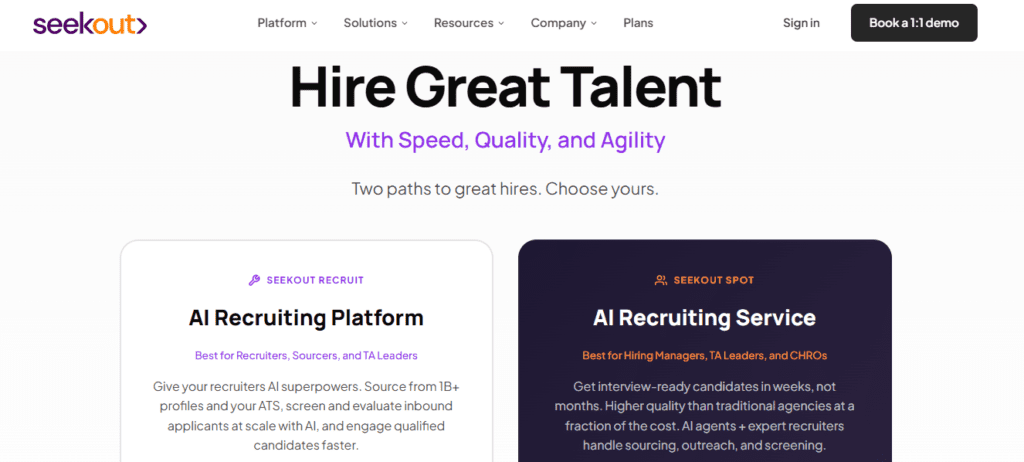
SeekOut is an AI sourcing platform that helps recruiters identify passive candidates by aggregating professional data and applying advanced search filters.
Pro: Strong diversity and technical talent sourcing filters.
Con: Limited applicant tracking capabilities.
Limitation: Primarily focused on sourcing, not full-cycle recruiting.
Who is it for: Technical recruiters and diversity hiring teams.
Pricing: Tier-based subscription plans. From $799/month!
4. hireEZ
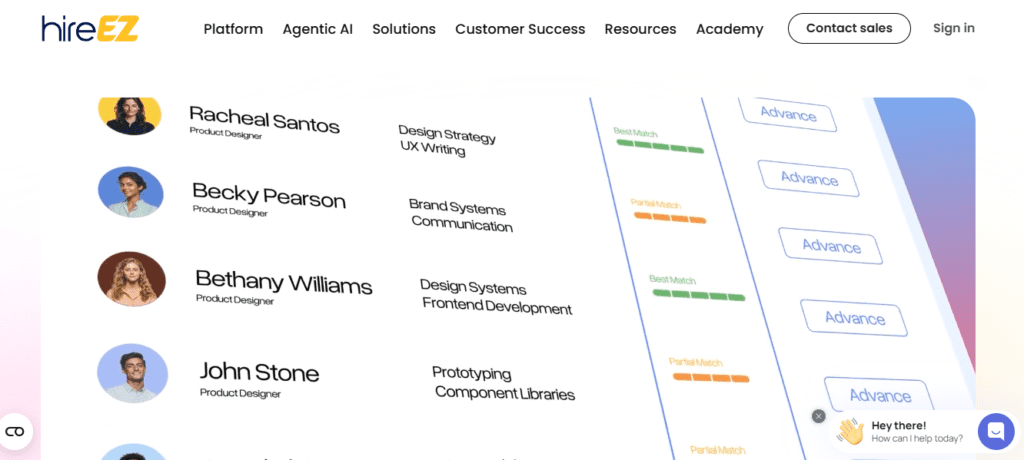
hireEZ is an AI-powered sourcing and outreach platform that combines candidate discovery with automated email sequencing.
Pro: Large global talent database.
Con: Outreach templates often require manual personalization.
Limitation: Not a complete applicant tracking system.
Who is it for: Mid-to-large recruiting teams focused on outbound sourcing.
Pricing: Custom pricing. Contact Sales!
5. Paradox (Olivia)
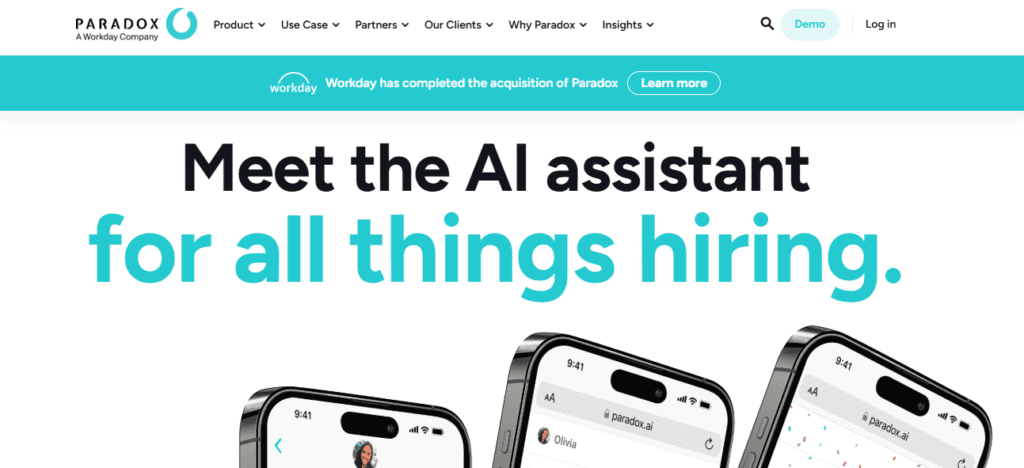
Paradox offers Olivia, a conversational AI chatbot that automates candidate engagement, screening questions, and interview scheduling.
Pro: Significantly reduces scheduling delays in high-volume hiring.
Con: Chatbot conversations can feel scripted.
Limitation: Limited deep skill-based screening capability.
Who is it for: High-volume employers in retail, hospitality, and frontline hiring.
Pricing: Ask for a demo
6. Metaview
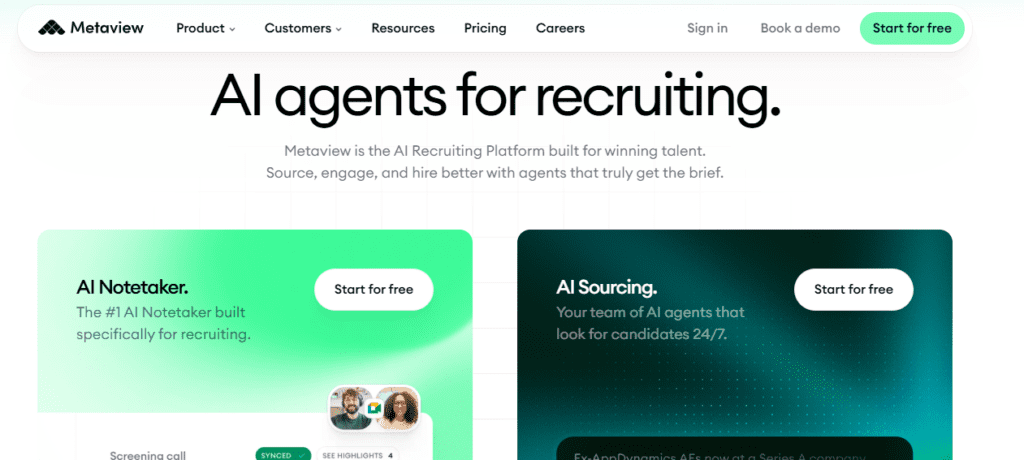
Metaview is an AI recruiting assistant that captures and structures interview notes automatically during live conversations.
Pro: Saves recruiters time on documentation and feedback writing.
Con: Requires integration with video interview platforms.
Limitation: Supports evaluation but does not replace hiring decisions.
Who is it for: Interview-heavy recruiting teams.
Pricing: Freemium subscriptions starting at $50 per month, plus custom plans.
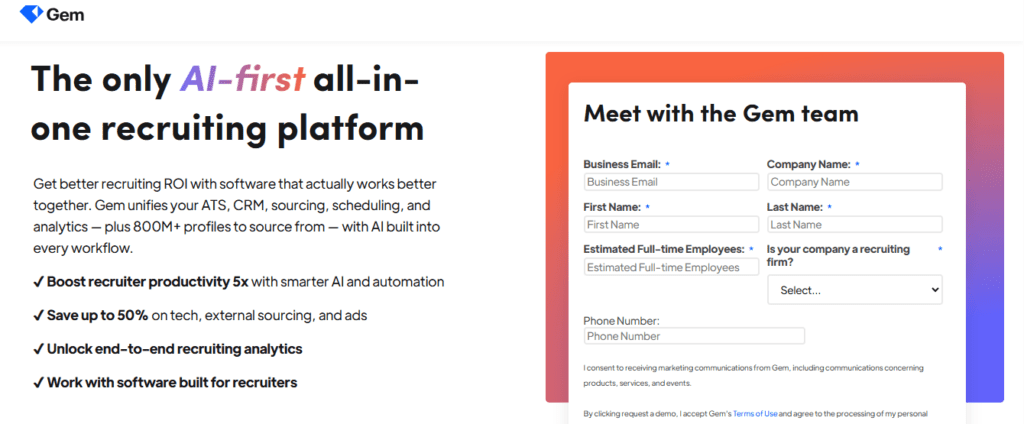
7. Gem
Gem is a recruiting CRM platform that automates outreach, tracks pipelines, and provides analytics across sourcing and engagement workflows.
Pro: Strong visibility across recruiting funnels.
Con: CRM setup requires structured data discipline.
Limitation: Not a standalone ATS replacement.
Who is it for: Data-driven recruiters and outbound sourcing teams.
Pricing: Starting from $135 with multiple Custom plans.
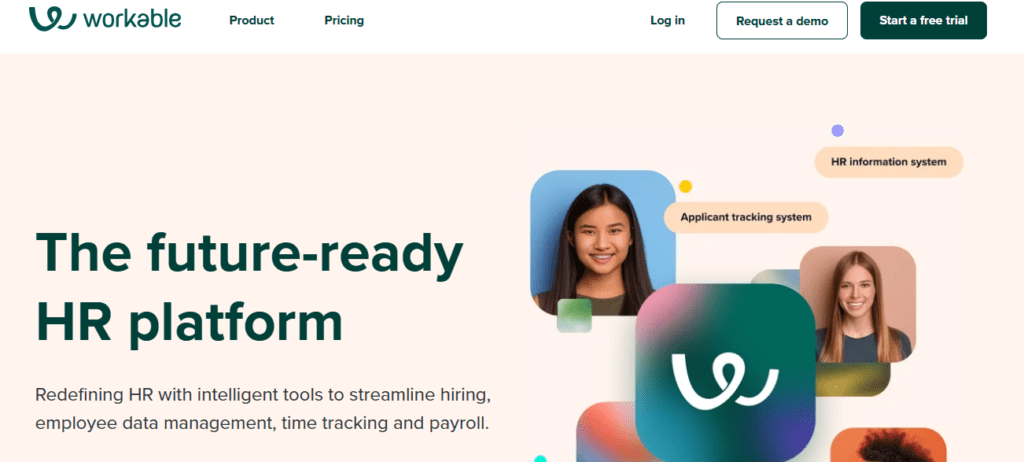
8. Workable
Workable is an AI-powered applicant tracking system that includes resume parsing, job posting distribution, and basic screening automation.
Pro: Beginner-friendly interface for SMB hiring teams.
Con: Limited enterprise-level analytics.
Limitation: Lighter AI depth compared to advanced talent intelligence tools.
Who is it for: Small and mid-sized businesses.
Pricing: Free trial with plans starting from $360/Month.
9. Greenhouse
Greenhouse is a structured hiring platform that provides workflow automation, interview scorecards, and hiring analytics.
Pro: Strong standardized interview process support.
Con: Higher pricing compared to SMB-focused tools.
Limitation: Not designed primarily for outbound sourcing.
Who is it for: Process-driven and scaling companies.
Pricing: Request a demo.
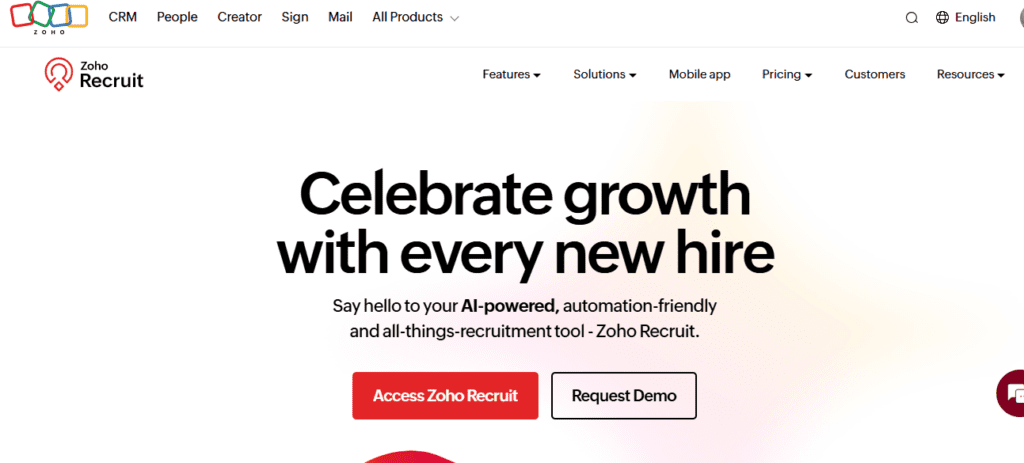
10. Zoho Recruit
Zoho Recruit is an AI recruiting software platform that offers resume parsing, candidate ranking, and workflow management for agencies and small teams.
Pro: Budget-friendly compared to enterprise ATS platforms.
Con: Basic AI automation depth.
Limitation: Limited advanced predictive analytics.
Who is it for: Small agencies and startups.
Pricing: Freemium with plans starting from $30/user/month.
11. Manatal
Manatal is an AI-driven applicant tracking system that recommends candidates based on job requirements and profile data.
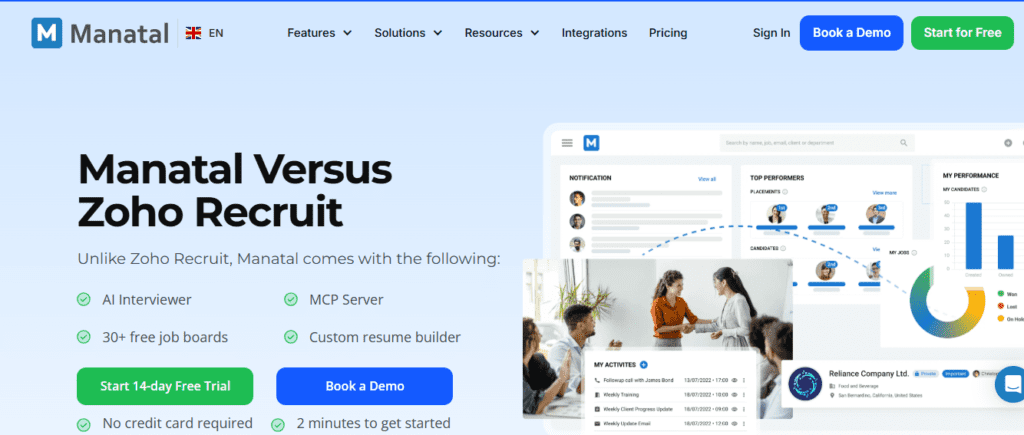
Pro: Easy onboarding and clean dashboard.
Con: Lighter reporting compared to enterprise ATS systems.
Limitation: Less suited for complex global hiring environments.
Who is it for: Growing teams and recruitment agencies.
Pricing: Multiple plans starting from $19/user/month.
12. TurboHire
TurboHire is an AI resume screening and structured evaluation platform designed to automate shortlisting and assessment workflows.
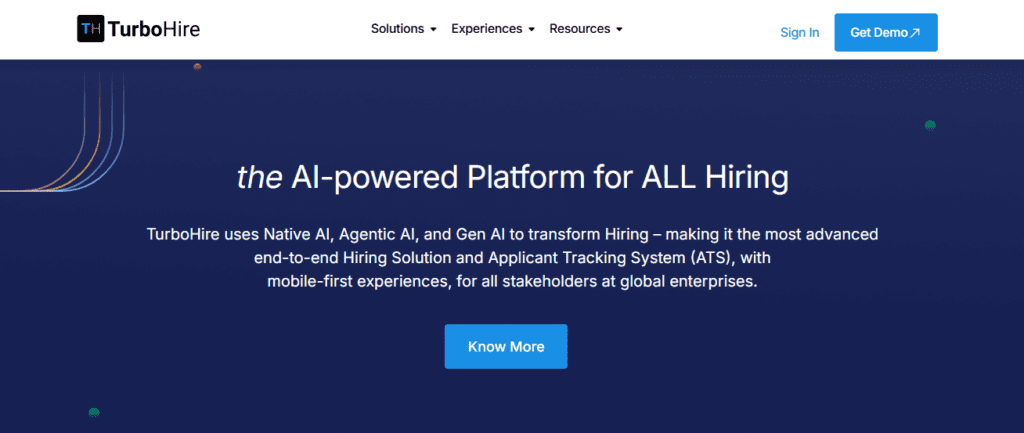
Pro: Strong automation for candidate shortlisting.
Con: The interface requires training to be fully used.
Limitation: Focused primarily on the screening stage.
Who is it for: Mid-size enterprises.
Pricing: Custom pricing.
13. Peoplebox.ai
Peoplebox.ai combines recruiting workflows with structured evaluation and performance alignment tools.
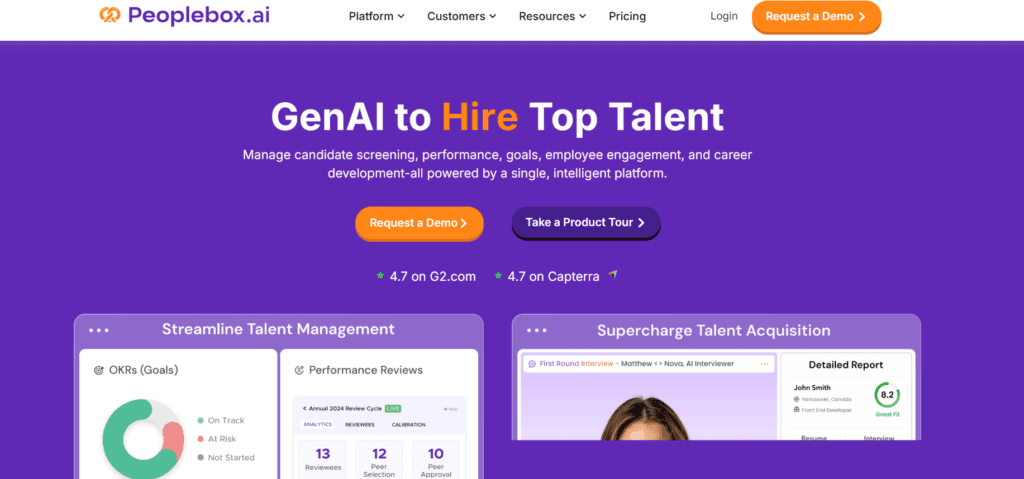
Pro: Connects hiring data with performance tracking insights.
Con: Broader HR positioning beyond recruiting.
Limitation: Not built as a sourcing-first platform.
Who is it for: HR-led and performance-focused organizations.
Pricing: Custom pricing starting from $8 /emp/month (billed annually)
14. iSmartRecruit
iSmartRecruit is an AI recruiting tool offering outreach automation, candidate engagement tracking, and workflow management.
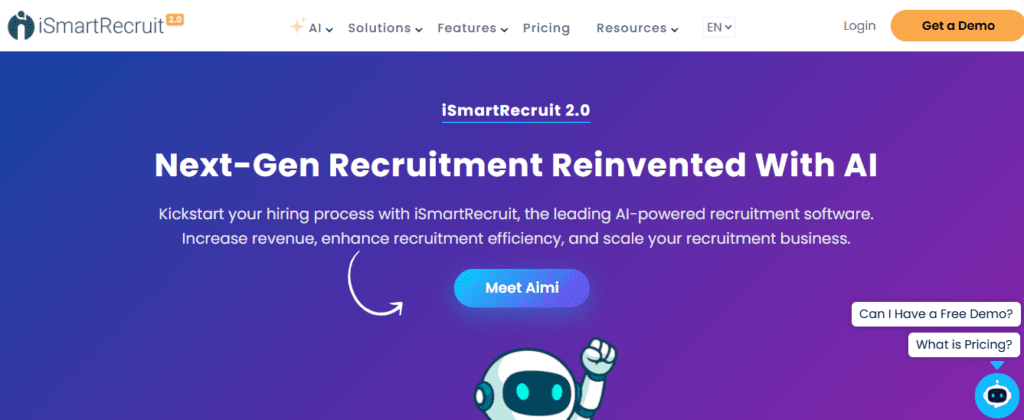
Pro: Multi-channel candidate communication automation.
Con: Smaller integration ecosystem.
Limitation: Limited enterprise-level analytics.
Who is it for: Recruitment agencies and staffing firms.
Pricing: Reach out to sales and get a price quote.
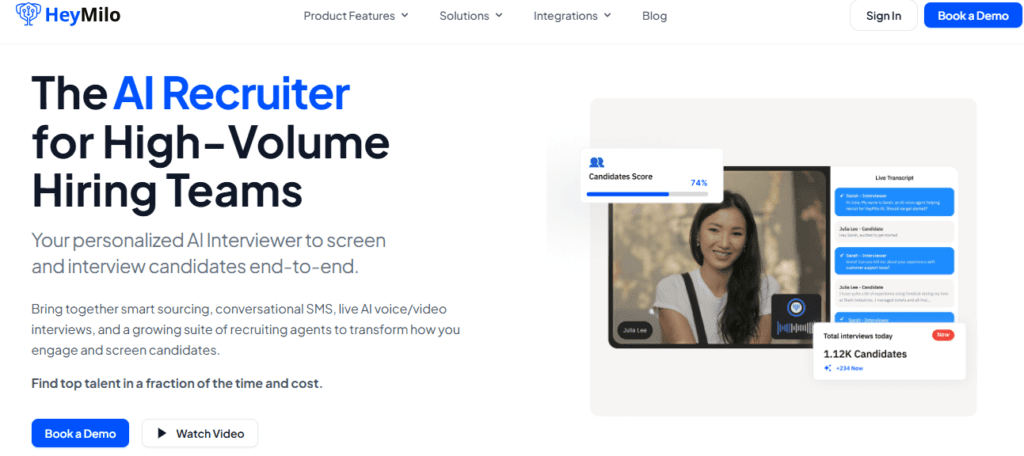
15. HeyMilo
HeyMilo is an AI-powered recruiting platform covering sourcing, screening, and workflow automation for growing hiring teams.
Pro: Broad automation coverage across recruiting stages.
Con: Newer presence compared to established enterprise tools.
Limitation: Expanding enterprise integrations.
Who is it for: Scaling startups and mid-size teams.
Pricing: Book a demo.
How to Choose the Right AI Recruiting Tool in 2026?
Choose AI recruiting software based on hiring volume, sourcing complexity, interview structure, candidate data management needs, integration requirements, and long-term budget alignment.
The right AI tool should support your recruiting processes without adding workflow friction or unnecessary technical complexity. Selecting a tool means choosing software that aligns with your hiring model, recruiter capacity, and growth stage.
Different recruiting teams need different levels of automation. A startup managing 20 hires per year has very different needs than an enterprise hiring across global regions.
Below is a structured decision framework to guide your selection:
- High-Volume Hiring
If you manage bulk or frontline recruiting, prioritize video interview automation, AI-powered scheduling, and chatbot-driven candidate engagement.
Why it matters: High-volume recruiting depends on speed, structured screening, and consistent evaluation.
- Technical Sourcing
If your focus is engineering or specialized roles, prioritize AI-powered sourcing platforms with deep talent graph search, passive candidate discovery, and advanced Boolean alternatives.
Why it matters: Technical recruiting requires precision in skill matching and in identifying passive talent.
- SMB Hiring
For small and mid-sized businesses, choose an applicant tracking system with built-in AI resume parsing, job description optimization, and basic candidate ranking.
Why it matters: SMB teams benefit from simplified workflows and consolidated recruiting processes.
- Enterprise Scale
For large organizations, select AI-driven talent intelligence platforms with predictive matching, bias mitigation controls, API access, and cross-regional compliance management.
Why it matters: Enterprise hiring requires scalability, governance, and data security.
Decision Matrix
| Hiring Need | Recommended Tool Type |
| High Volume Hiring | AI screening tool + AI-powered ATS |
| Passive candidate sourcing | Automated Sourcing Platform |
| Structured Interviews | Video Interview AI system |
| Enterprise Compliance | Talent Intelligence Platform |
How Do AI Recruiting Tools Improve Hiring Processes?
AI recruiting tools improve hiring processes by automating resume review, ranking candidates using skills-based matching, scheduling interviews, and centralizing applicant data. This accelerates talent acquisition while improving evaluation consistency, reducing exposure to bias, and strengthening hiring accuracy.
Organizations adopting AI recruiting software report 30-40% lower hiring costs and nearly 50% faster time-to-hire, underscoring measurable ROI from automation and intelligent screening.
The following table explains how AI functions translate into measurable hiring outcomes.
How AI Impacts Recruiting Workflows
| Recruiting Task | AI Function | Outcome |
| Automated Sourcing | Skill graph mining | Stronger candidate pipeline |
| Candidate Screening | Resume Parsing & Ranking | Faster Shortlisting |
| Video Interview | Structured response analysis | Consistent evaluation |
| Job description | AI optimization & keyword analysis | Higher quality applicants |
| Hiring decisions | Predictive matching models | Reduced mis-hires |
What Are the Risks of Using AI in Hiring?
AI recruiting tools can introduce algorithmic bias, reduce transparency, and create over-dependence on automated decision systems if not properly monitored. Organizations must combine artificial intelligence with structured human oversight to protect fairness, candidate trust, and regulatory compliance.
AI in hiring improves efficiency, but it also introduces measurable risks. These risks do not come from artificial intelligence itself. They typically emerge from poor data quality, weak governance, or a lack of recruiter supervision.
Below are the primary risks organizations should evaluate before implementing AI recruiting systems.
Key Risks of AI in Hiring
- Bias Amplification
AI systems learn from historical hiring data. If past hiring decisions reflected unconscious bias or limited diversity, the system may replicate or reinforce those patterns.
Why it matters: Without bias audits and dataset reviews, AI can amplify existing inequalities rather than correct them. The U.S. Equal Employment Opportunity Commission has issued clear guidance that employers remain liable for discriminatory outcomes even when AI tools are involved.
- Black-Box Scoring
Some AI recruiting platforms provide candidate rankings without clear explanations of how scores are calculated.
Why it matters: Lack of transparency reduces recruiter accountability and may create legal risk in regulated markets.
- Data Misuse and Privacy Exposure
AI recruiting software processes large volumes of candidate data, including resumes, behavioral signals, and, in some cases, video interviews.
Why it matters: Weak data governance can create compliance risks under privacy regulations and damage employer brand trust.
- Over-Reliance on Automation
Automating sourcing, screening, and scheduling improves speed. However, fully delegating evaluation decisions to AI systems can weaken recruiter judgment.
Why it matters: Hiring decisions require contextual understanding, cultural alignment, and role nuance that automated systems cannot fully assess.
Risk Mitigation Strategy
Responsible AI hiring requires:
- Human review checkpoints
- Bias testing and model audits
- Clear documentation of scoring logic
- Data privacy controls
- Structured interview frameworks
AI Recruiting vs Traditional Hiring Methods
AI recruiting software automates candidate sourcing, screening, and interview coordination, while traditional hiring depends on manual resume review and recruiter-driven workflows. AI systems improve efficiency and scalability, but human recruiters remain critical for contextual evaluation and final hiring decisions.
Both AI-driven and traditional hiring approaches aim to identify qualified candidates. The difference lies in execution speed, data processing capacity, and evaluation structure.
Below is a side-by-side comparison.
AI Recruiting vs Traditional Hiring
| Factor | AI Recruiting | Traditional hiring |
| Speed | High-volume processing in minutes | Manual review over days or weeks |
| Bias Control | Structured scoring with audit potential | Dependent on individual judgment |
| Scalability | Easily scales across regions and roles | Limited by recruiter capacity |
| Personal Judgement | Data-driven evaluation support | Strong human intuition and context |
What Is the Future of AI Recruiting Beyond 2026?
Beyond 2026, AI recruiting will shift from task automation to autonomous recruiting agents, real-time skills intelligence, continuous workforce forecasting, and explainable AI governance. Organizations will use artificial intelligence to manage end-to-end talent pipelines while strengthening transparency, compliance, and human oversight.
AI recruiting is moving from assistive automation toward system-level orchestration. The next phase is not just faster screening. It is an intelligent workforce infrastructure.
Here is what is realistically shaping the next stage.
1. Autonomous Recruiting Agents
AI agents will independently execute sourcing, outreach personalization, interview coordination, follow-ups, and pipeline updates within defined guardrails.
What changes: Recruiters supervise strategy while AI manages workflow execution.
2. Real-Time Skills Intelligence
Recruiting platforms are transitioning from resume-based matching to continuously updated skills graphs that track emerging competencies across industries.
What changes: Hiring decisions rely less on job titles and more on verified capability signals.
3. Explainable AI in Hiring
Regulatory pressure is increasing around algorithmic transparency. Future AI recruiting software will provide explainable candidate scoring and audit-ready documentation.
What changes: Black-box ranking models decline. Compliance-ready AI becomes mandatory for enterprises.
4. Predictive Workforce Forecasting
AI systems will connect recruiting data with business metrics to forecast hiring demand, internal mobility gaps, and succession risk.
What changes: Talent acquisition shifts from reactive recruiting to predictive workforce planning.
5. Human-AI Governance Models
Leading organizations are implementing structured human review checkpoints in AI-driven hiring workflows.
What changes: Ethical oversight becomes embedded in system design rather than added after deployment.
FAQ
Are AI recruiting tools biased?
AI recruiting tools can reflect bias if trained on biased data. Modern AI-driven systems include bias detection and monitoring controls, but human oversight remains essential for fair hiring decisions.
Is AI hiring legal in 2026?
AI hiring is legal in many regions, but compliance requirements are increasing. Recruiters must ensure transparency, candidate consent, and regulatory alignment when using AI recruiting software.
Can AI replace recruiters?
AI tools automate recruiting processes, but they do not replace recruiters. Human judgment remains critical for evaluating cultural fit, leadership traits, and final hiring decisions.
What are the benefits of AI in recruitment?
The main benefits of AI recruiting include:
- Faster resume screening
- Reduced hiring costs
- Improved candidate matching
- Automated interview scheduling
- Data-driven hiring decisions
Companies use AI to reduce time-to-hire and improve talent quality.