AI tools for medical students are applications that assist with studying, research, clinical learning, and exam preparation. The tools help by explaining concepts, summarizing content, organizing notes, and enhancing learning. However, the decision should always remain with humans.
Medical education demands precision, speed, and deep understanding. AI tools help medical students manage volume, reinforce concepts, and study more efficiently, but only when used within clear academic and ethical boundaries.
This guide explains what AI tools do for medical students, how they are used in their study workflows, and where their limits begin.
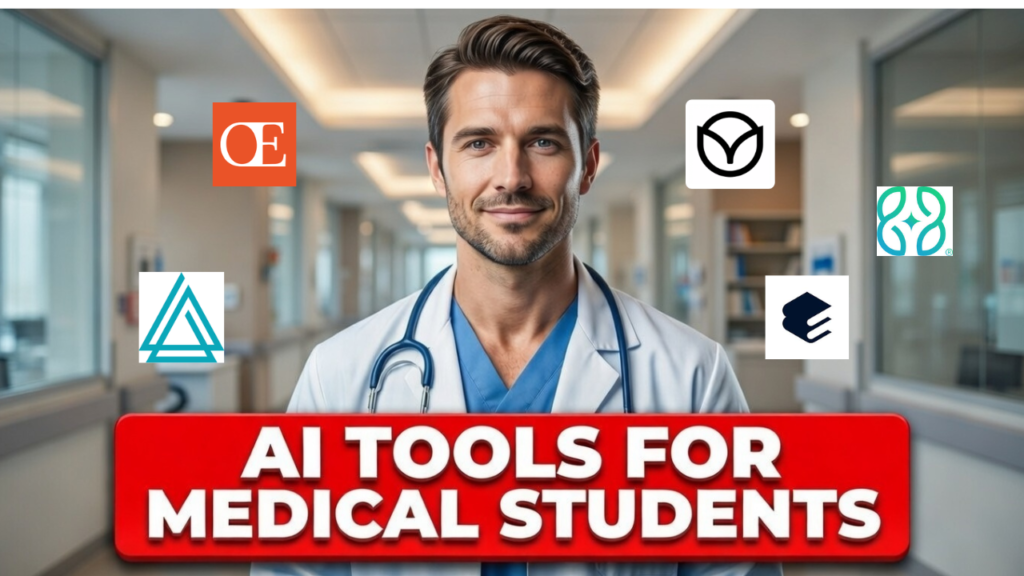
What Are AI Tools for Medical Students
AI tools for medical students are learning-support software that use artificial intelligence to process medical text, a technique also used in AI content marketing.
They help students understand, organize, and review information more efficiently, particularly when dealing with dense materials such as textbooks, lectures, or research papers.
What AI Tools Are
- Educational assistants for studying and revision
- Software that explains medical concepts in simpler terms
- Tools that summarize academic literature and guidelines
- Systems that support note-taking, flashcards, and spaced repetition
What AI Tools Are Not
- Diagnostic systems
- Treatment planners
- Clinical decision-making authorities
- Substitutes for supervision, patient contact, or exams
AI in medical education supports comprehension, synthesis, and revision. It does not make diagnoses, replace clinical supervision, or override accredited medical instruction. This difference is important for both academic honesty and patient safety.
How Medical Students Use AI Tools
Medical students use AI tools to support learning tasks, not to bypass effort or responsibility. The most effective use cases align with how medicine is taught and assessed.
Studying & Knowledge Reinforcement
AI tools help students cover complex learning material with ease and without wasting time. Common uses include:
- Simplifying pathophysiology mechanisms step by step
- Explaining pharmacology interactions in plain language
- Reframing dense lecture slides into structured summaries
AI tools for medical students are most effective after lectures, when students already have foundational exposure.
Research & Evidence Review
Medical research requires accuracy, not shortcuts. Students use AI tools to:
- Summarize peer-reviewed papers and clinical guidelines
- Extract key findings and limitations
- Speed up literature scanning before deep reading on platforms like Google Scholar.
Important limitation:
AI does not replace full-text reading or critical appraisal. It only accelerates orientation.
Clinical Learning Support (Educational Context Only)
During the preclinical and clinical years, AI tools assist with reasoning frameworks rather than with decisions. Appropriate uses include:
- Understanding the diagnostic pathways conceptually
- Learning how clinicians structure differential diagnoses
- Reviewing clinical reasoning patterns used in textbooks
AI does not provide patient-specific advice or clinical instructions.
Exam & Revision Preparation
AI tools support structured revision, especially for high-volume exams. Common applications:
- Generating flashcards aligned with learning objectives
- Supporting spaced repetition schedules
- Explaining why specific answers are correct or incorrect
This improves retention, not exam shortcuts.
Safety & Academic Integrity Reminder
Responsible AI use in medical education follows three rules:
- No patient-specific decisions
- No replacement of formal teaching
- No unverified clinical claims
When used appropriately, AI tools enhance learning efficiency without compromising professional standards. ust as medical students need focus, graduates can use AI Tools for Job Seekers to enter the workforce.
Why Medical Students Are Using AI Tools
Medical students adopt AI tools for measurable learning outcomes. The value lies in how these tools support demanding study cycles without lowering academic standards.
Faster Understanding of Complex Medical Concepts
AI tools help students process difficult topics more efficiently. They:
- Explain multi-step mechanisms clearly
- Break down layered concepts like physiology and pharmacology
- Reduce time spent stuck on unclear explanations
This results in better understanding at an earlier stage, preventing skipped learning.
Reduced Cognitive Overload During Heavy Study Periods
Medical curricula create unavoidable information density. AI tools reduce overload by:
- Structuring scattered notes into logical formats
- Summarizing long materials without removing context
- Helping students prioritize what to review first
This supports mental clarity during exams and rotations.
Improved Retention Through Structured Explanations
Retention improves when information is presented in a clear structure. AI tools support this by:
- Connecting concepts instead of listing facts
- Reinforcing cause-and-effect relationships
- Aligning explanations with how exams test reasoning
Better structure leads to longer recall, not memorization.
More Efficient Research and Note Organization
Research efficiency matters when time is limited. Students use AI tools to:
- Organize references and key points
- Extract relevant sections from large documents
- Maintain cleaner, searchable study notes
This improves workflow without altering academic rigor.
Stronger Self-Directed Learning Habits
Medical education rewards independent learning. AI tools encourage this by:
- Helping students identify weak areas
- Supporting revision without constant supervision
- Enabling consistent daily study routines
The result is better learning discipline, not dependency.
What AI Tools Cannot Replace in Medical Education?
AI tools have strict limits in medical education. Respecting these limits protects both students and patients.
Clinical Judgment and Supervision
Clinical judgment develops through:
- Supervised patient exposure
- Real-time decision-making
- Feedback from experienced clinicians
AI tools cannot replicate clinical responsibility or accountability.
Ethical Decision-Making
Ethical Decision-Making requires human judgment and should align with established medical ethics. Ethics requires human judgment. AI tools:
- Do not understand patient values
- Cannot weigh moral responsibility
- Cannot assume professional liability
Ethical reasoning remains a human obligation.
Patient Interaction and Examination
Patient care depends on:
- Communication skills
- Physical examination techniques
- Empathy and observation
AI tools do not replace bedside learning or clinical presence.
Accredited Teaching, Assessment, and Certification
Medical qualifications rely on:
- University-led instruction
- Regulated assessments
- National and international accreditation
AI tools do not issue credentials and do not replace formal evaluation. They assist education but do not perform medicine. This boundary ensures:
- Academic integrity
- Professional safety
- Long-term trust in medical training
Categories of AI Tools for Medical Students
Medical students encounter AI tools at different points in training. These categories reflect how AI supports learning progression, from early coursework to advanced clinical reasoning, without crossing professional boundaries.
These tools assist understanding, organization, and educational reasoning. They do not diagnose, prescribe, or replace supervised clinical learning.
AI Tool Categories Used in Medical Education
| Category | What Does It Help With | Example Tools* | Best Used For |
| AI Study Assistants | Concept Explanation, summaries, clarification | MedicalStudent.ai, AMBOSS AI | Daily studying and Topic reinforcement |
| Research & Evidence Tools | Paper Synthesis, guideline summaries | OpenEvidence, Elicit | Literature review & Evidence scanning |
| Learning & Note Tools | Lecture Digestion, structured recall | Mindgrasp, Notion AI | Exam preparation & revision |
| Clinical Learning Support | Educational reasoning frameworks | Arkangel.ai, Isabel (educational use) | Advanced learning and case reasoning practice |
| General AI Assistants | Broad explanations, Q&A support | ChatGPT, Claude | Clarification and concept revision |
Examples reflect real-world usage and publicly discussed reviews. They are not endorsements or clinical recommendations.
How to Interpret These Categories
- Pre-clinical students rely more on study and note-taking tools for foundational subjects.
- Clinical-stage students primarily use AI to understand reasoning patterns, rather than to make decisions.
- Research-focused learners benefit from evidence-based tools that accelerate reading, not replace it.
Each category supports a specific educational task, which improves learning efficiency when used responsibly.
Safety and Scope Reminder
AI tools in these categories:
- Support comprehension and synthesis
- Operate within an educational context
- Require human verification and supervision
They do not function as medical authorities.
Best AI Tools for Medical Students in 2026
Tools are selected based on educational relevance, documented global adoption, clarity of medical learning use cases, and alignment with accepted medical education standards, rather than on promotional reach.
This section is designed for high-intent users deciding which tool fits their stage of training. Each tool below is intended for educational use only:
How Each Tool Is Evaluated
Each tool is reviewed using the same criteria to ensure fairness and clarity:
- What it helps with
- Medical student use case
- Best-fit learner stage
- Limitations & cautions
- Academic & ethical considerations
- Curriculum alignment
- Pricing transparency
Study & Learning Support Tools
Best for: Structured medical explanations
Use case: Learning core concepts in plain, student-friendly medical language
Best suited for: Pre-clinical medical students
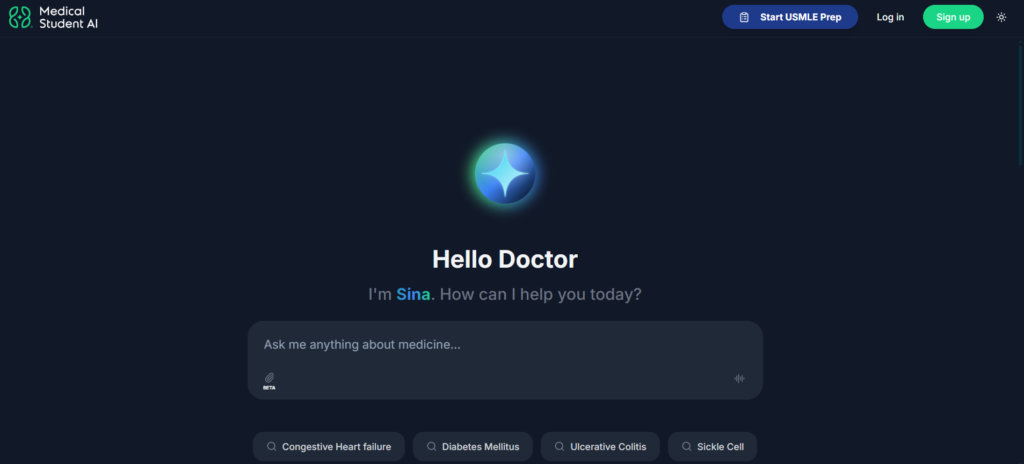
MedicalStudent.ai focuses on conceptual clarity. Students use it to break down physiology, pathology, and pharmacology topics before verifying details in standard textbooks.
Limitations & cautions:
- Explanations must be cross-checked with curriculum-approved resources
- Not designed for clinical decision-making
Academic alignment:
- Supports foundational learning and exam preparation
- Complements lecture notes and standard references
Pricing (2026): Free access with optional paid study features (Starting from $20/Month)
- AMBOSS (AI-Assisted Features)
Best for: Integrated learning with clinical context
Use case: Reinforcing concepts using question-based and case-linked explanations
Best suited for: Pre-clinical students and exam-focused learners
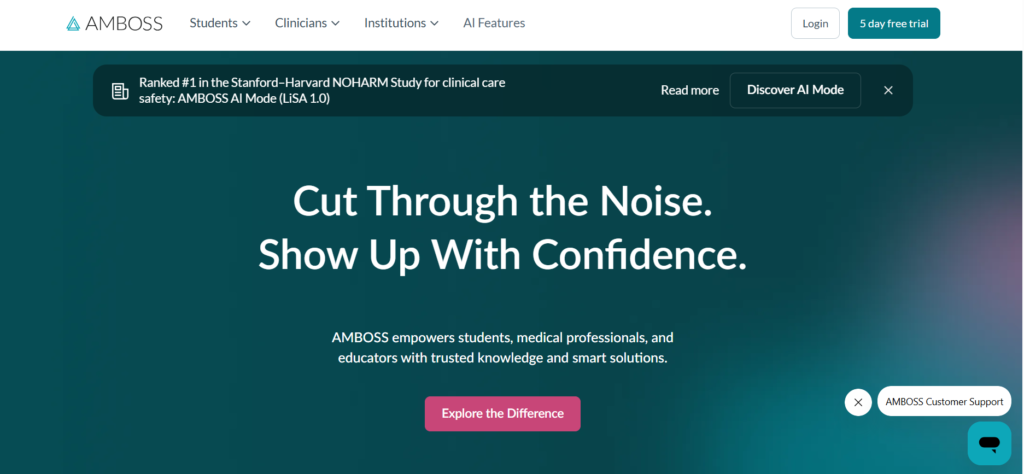
AMBOSS combines its established medical library and question bank with AI-assisted explanations that help students connect facts to clinical relevance.
Limitations & cautions:
- AI suggestions do not replace textbook or guideline verification
- Requires active learning to avoid surface-level understanding
Academic alignment:
- Widely aligned with medical school curricula and licensing exams
- Strong support for structured exam preparation
Pricing (2026): Free trial with paid student subscription starting from $19.99/Month.
Research & Evidence Understanding Tools
Best for: Evidence exploration and structured summarization
Use case: Faster understanding of studies, reviews, and clinical guidelines
Best suited for: Research-oriented students and senior learners
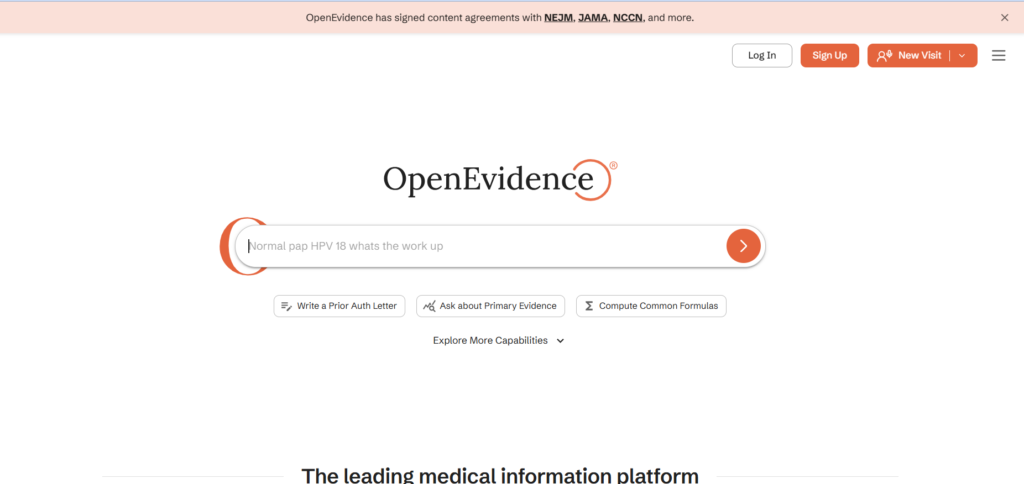
OpenEvidence helps medical students navigate medical literature efficiently by summarizing evidence while keeping references visible for verification.
Limitations & cautions:
- Not a substitute for reading full papers
- Interpretation still requires critical appraisal skills
Academic alignment:
- Supports evidence-based medicine education
- Useful for guideline familiarity and research literacy
Pricing (2026): Free access available; expanded features may require a subscription.
- Elicit
Best for: Literature discovery and synthesis
Use case: Mapping research questions to existing evidence
Best suited for: Academic projects, theses, and systematic exploration
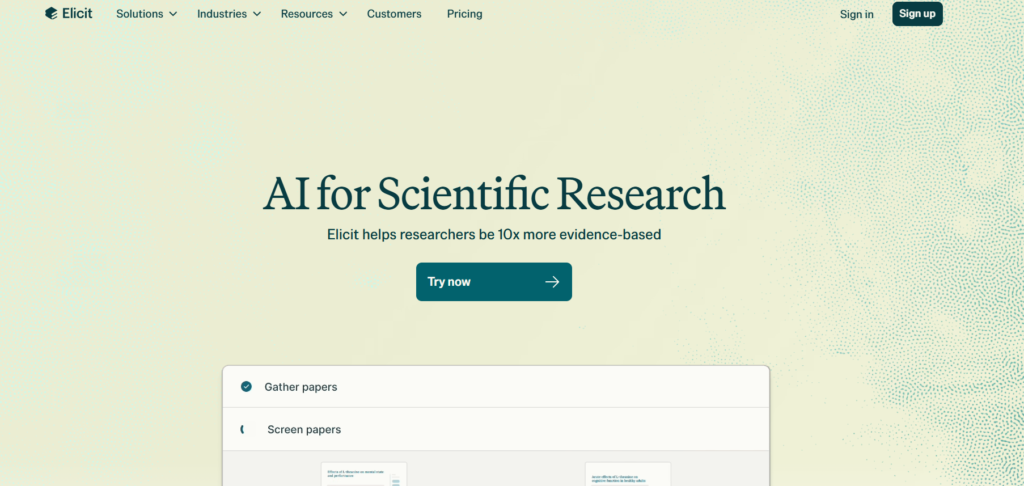
Elicit is commonly used by students to identify relevant studies, extract key findings, and organize research questions during academic work.
Limitations & cautions:
- Output quality depends on prompt clarity
- Does not replace formal systematic review methods
Academic alignment:
- Supports research methodology learning
- Encourages structured evidence evaluation
Pricing (2026): Free tier available with paid plans for advanced research workflows starting from $12/Month.
Clinical Learning & Reasoning Support
Best for: Pattern recognition and framework learning
Use case: Understanding how clinical data informs reasoning pathways
Best suited for: Advanced medical students
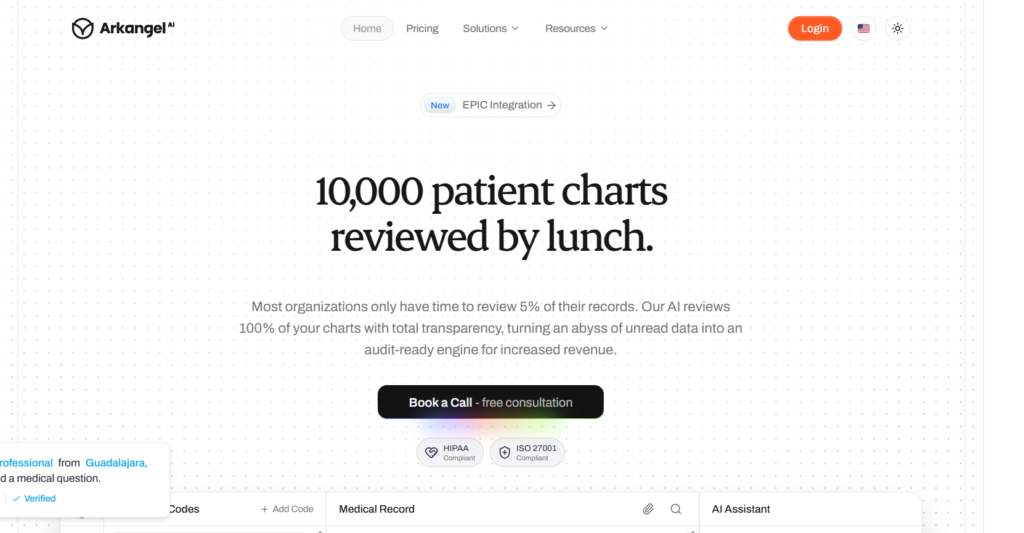
Arkangel.ai is used in educational settings to examine how structured data can support clinical reasoning models, rather than to inform decision-making.
Limitations & cautions:
- Educational use only
- Not a clinical authority or diagnostic system
Academic alignment:
- Supports higher-level reasoning discussions
- Useful for supervised learning environments
Pricing (2026): Institutional or educational access with pricing plans starting from $20/Month
- Isabel (Educational Use)
Best for: Learning differential diagnosis structures
Use case: Exploring diagnostic reasoning pathways in a supervised context
Best suited for: Clerkship-level learners
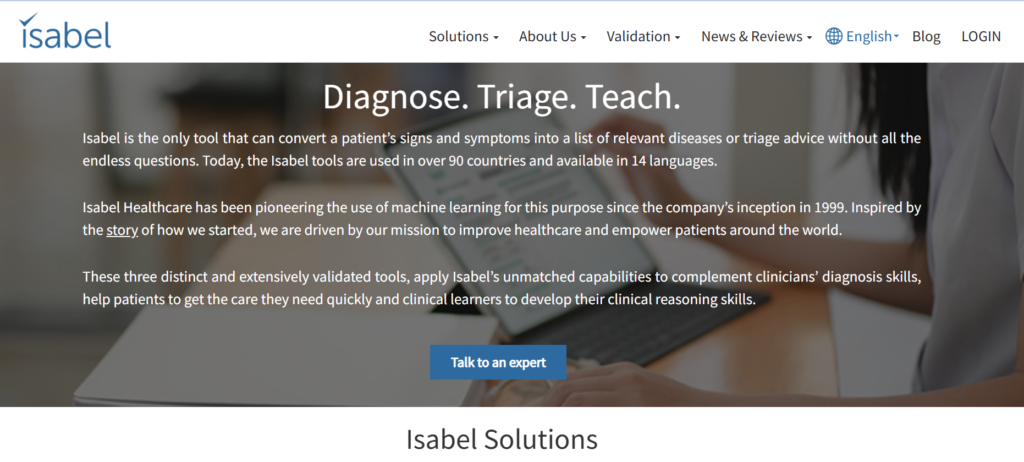
Isabel is widely cited in medical education for teaching clinicians how to structure differentials, not for independent diagnosis.
Limitations & cautions:
- Not for unsupervised clinical decisions
- Requires contextual medical judgment
Academic alignment:
- Used in teaching diagnostic reasoning
- Supports structured clinical thinking
Pricing (2026): Typically institution-licensed; individual access varies
General AI Tools in Medical Education (Safe Use Context)
Common educational uses:
- Clarifying difficult concepts
- Generating practice explanations
- Structuring revision schedules
General AI tools must be used alongside verified medical sources and in compliance with institutional academic policies. They support learning but do not independently validate medical accuracy.
How to Choose the Right AI Tool as a Medical Student
Choosing the right AI tool depends on where you are in training and what task you need support with. Medical AI tools perform best when they align with a clear learning objective and enable verification against trusted sources.
Practical Checklist for Selection
- Your study stage
Pre-clinical students benefit from concept explanation and structured summaries. Clinical and clerkship students need reasoning frameworks, not automated answers.
- Primary task
Use study assistants for learning mechanisms, research tools for evidence review, and note-taking tools for revision and recall.
- Accuracy and source transparency
Prefer tools that cite textbooks, journals, or guidelines and indicate the sources of information.
- Compliance with academic rules
Confirm the tool aligns with your university’s AI usage and assessment policies.
- Ability to verify outputs
Select tools that facilitate straightforward cross-checking against standard medical references.
Key takeaway:
The best AI tool is the one that supports learning without bypassing reading, supervision, or critical thinking.
Ethics, Accuracy & Academic Integrity in AI Use
Responsible use of AI is essential in medical education. These tools support learning but do not replace professional standards or academic responsibility.
Core Principles for Safe Use
- Always cross-check medical information
Verify AI outputs with textbooks, peer-reviewed journals, or clinical guidelines.
- Follow university AI usage policies
Institutions differ in the extent to which AI use is permitted for coursework and exams.
- Do not use AI for assessments unless allowed
Unauthorized use can violate academic integrity rules.
- Treat AI as a study aid, not an authority
Final understanding must come from accredited teaching and verified sources.
Ethical use of AI protects patient safety, academic credibility, and professional development.
Future of AI in Medical Education (2026-2028, Grounded)
AI in medical education is moving toward institution-led, curriculum-aligned systems. The next phase focuses on learning quality, governance, and accountability.
What’s Actually Changing
Curriculum-aligned AI tutors
Medical schools are piloting AI systems trained on approved syllabi, textbooks, and learning objectives to support concept clarification and revision.
Adaptive learning based on knowledge gaps
AI tools increasingly adapt explanations and practice questions based on a student’s performance, thereby helping to target weak areas in anatomy, pathology, or pharmacology.
Institution-controlled AI platforms
Universities are favouring closed, internally governed AI systems with strict data privacy rules, audit trails, and academic oversight.
Stronger emphasis on governance and ethics
AI use is being formalised through policies covering transparency, data ownership, and acceptable academic use.
Bottom line: Medical education will remain human-supervised, ethical, and patient-centred. AI will support learning efficiency, not replace training, mentorship, or clinical responsibility.
FAQs
Are AI tools allowed for medical students?
Yes, many universities permit the use of AI for study and research. Usage during assessments depends on institutional policy and must be verified with faculty guidelines.
Can AI replace studying medicine?
No. AI can support understanding and revision, but mastering medicine requires textbooks, supervised training, clinical exposure, and formal assessment.
Is AI accurate for medical learning?
AI can be accurate for explanations and summaries, but errors are possible. All outputs must be checked against trusted medical sources.
How should students verify AI outputs?
Students should cross-check information using standard textbooks, peer-reviewed journals, and official clinical guidelines.
Can AI tools be used during clinical rotations?
AI may be used for learning and reflection, provided the institution permits it. It should never guide real-time patient decisions or replace supervision.
Final Summary:
AI is becoming a structured learning assistant in medical education, but competence, ethics, and patient safety remain grounded in human training and accountability.