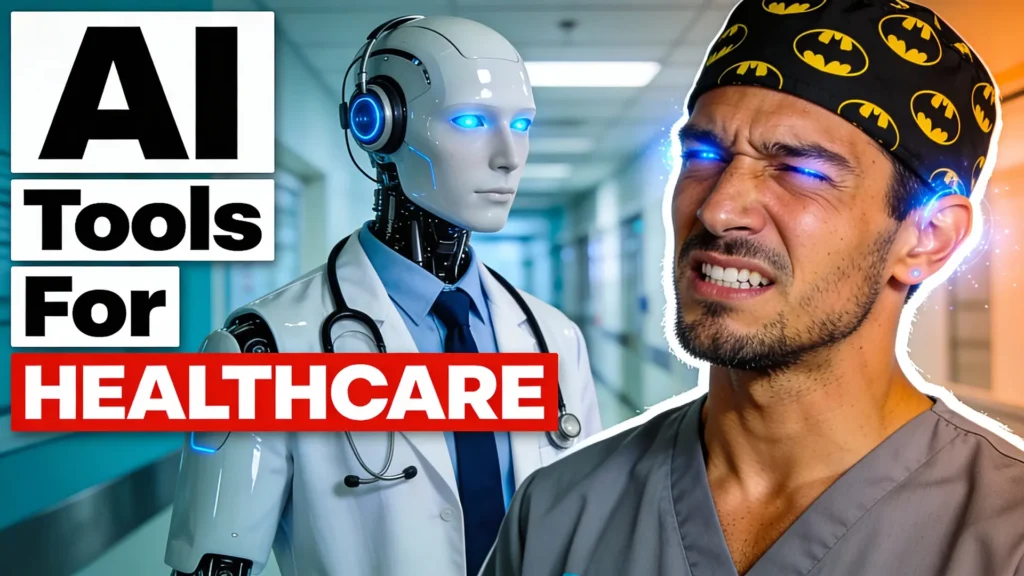
AI tools for healthcare are not experimental anymore. Hospitals now use them daily to read clinical notes, review CT scans, organize patient data, and reduce administrative overload, while doctors remain in control of every medical decision.
Healthcare doesn’t face a data issue; instead, it struggles with timing challenges. Doctors and nurses deal with patient records, reports, and updates all day long. Much of that work happens outside the exam room.
AI tools are starting to help by taking care of repetitive and data-heavy tasks, so clinicians can spend more time focused on patients instead of screens.
This guide will help you learn about AI tools for healthcare today. At Daily AI Tools, our expert team analyzes and tests every tool for performance. They have done some deep research on the workings of AI in healthcare and recommend tools that actually help.
Why AI Tools Matter in Healthcare Today
Most healthcare systems are overloaded, not understaffed. Patient data keeps growing. Clinical notes get longer. Imaging files get larger. But the number of hours in a shift stays the same. That gap is where AI tools are being used.
What AI tools are helping with in healthcare:
- Sorting and summarizing clinical notes
- Reviewing CT scans and flagging areas that need attention
- Organizing patient data across systems
- Supporting care teams with faster access to information
Instead of replacing medical judgment, these AI-Powered tools reduce friction. When routine tasks take less time, clinicians can focus on patient care. That leads to fewer delays, clearer communication, and better continuity across teams.
For healthcare organizations, it also means more consistent workflows and fewer errors caused by overload. AI tools don’t improve patient outcomes on their own. They help people do their jobs better.
How AI Works in Healthcare
Most AI tools in healthcare do one thing well. They look at large amounts of health data and help surface what matters.
AI tools for healthcare don’t “think” like doctors. They process patterns faster than humans can, then present findings for review. Every serious healthcare system keeps humans in control.
AI for Data Analysis & Prediction
Hospitals collect data from many places at once. The data includes patient records, lab results, vital signs, and treatment outcomes. On their own, these data points don’t say much.
AI tools analyze this data together. They look for patterns across electronic health records, labs, and historical outcomes. For example, an AI-powered system might notice early signs of patient risk based on changes that are easy to miss during a busy shift.
This kind of analysis helps care teams:
- Spot risk earlier
- Prioritize patients who need attention
- Support decisions with clearer context
The goal isn’t prediction for prediction’s sake. It’s helping clinicians act sooner, with better information.
AI in Medical Imaging & Diagnostics
Medical imaging produces thousands of images every day. Reviewing them carefully takes time, and delays can affect patient care.
AI tools are now used to analyze CT scans, MRIs, and X-rays as soon as they’re created. These systems highlight areas that may need closer review and help prioritize urgent findings.
In medical workflow, integrating AI means:
- Faster review of critical cases
- Better triage in emergency settings
- Fewer missed abnormalities
Radiologists remain responsible for diagnoses. AI helps them move faster and focus where it matters most.
Natural Language Processing for Clinical Documentation
Clinical notes are messy by nature. They’re written quickly, often under pressure, and stored as unstructured text.
Natural language processing helps turn those notes into usable data. NLP tools can:
- Extract key details from clinical notes
- Reduce manual data entry
- Catch documentation gaps or inconsistencies
By handling routine documentation work, these tools lower administrative burden and reduce errors caused by fatigue. Clinicians spend less time typing and more time with patients.
Top AI Tools in Healthcare (2026) – Clinical Use Cases
Many AI tools claim to “transform healthcare,” but in reality, only a few are consistently used within actual healthcare systems.
The tools below are grouped by what clinicians actually use them for. Each one solves a specific problem, works inside regulated environments, and supports medical professionals.
Clinical Decision Support & Personalized Care
These types of AI tools help clinicians make sense of complex patient data and support better care decisions without taking control away from humans.
IBM Watson Health (Merative AI)
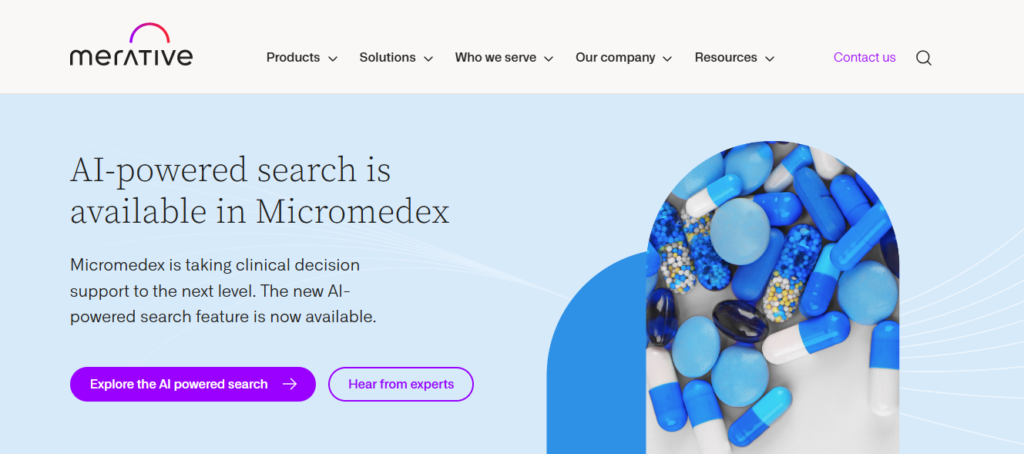
Merative AI: Used by healthcare organizations to analyze large volumes of patient data, clinical guidelines, and outcomes. It supports treatment planning and population health analysis, especially in complex cases where many variables matter.
Tempus
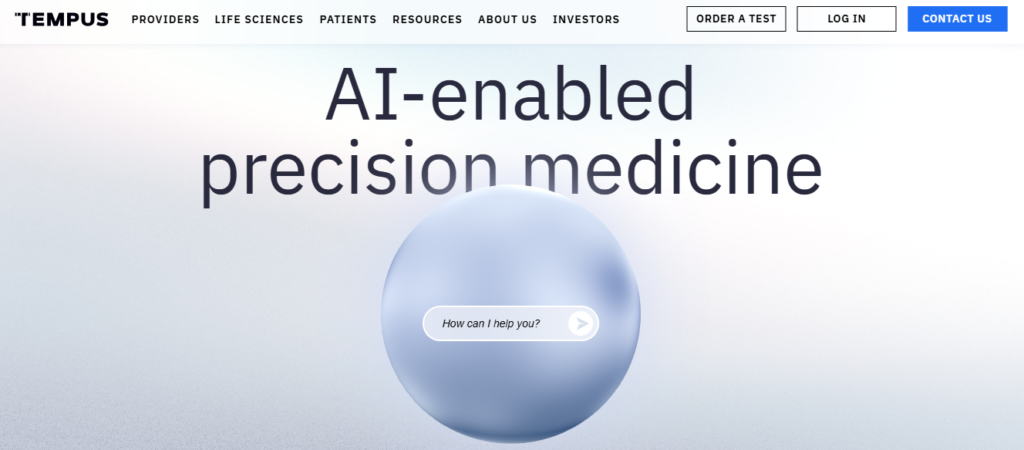
Focused on precision medicine. Tempus uses AI models to analyze clinical and molecular data, helping care teams personalize treatment decisions, especially in oncology. Its strength lies in linking patient data with real-world evidence.
Best for:
- Personalized care planning
- Data-driven treatment support
- Improving patient outcomes in complex conditions
Medical Imaging & Diagnostics
These AI-powered tools support radiologists by speeding up image review and flagging urgent findings.
Aidoc
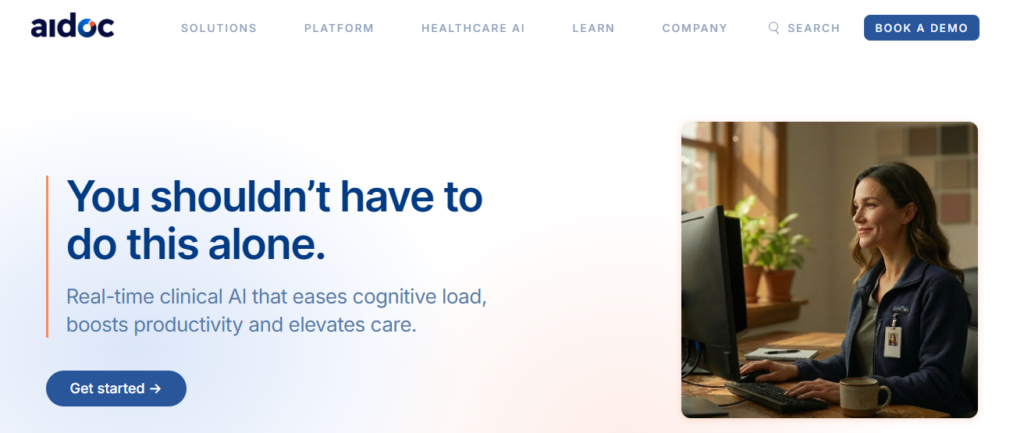
Aidoc AI: Widely used in hospitals to analyze CT scans in real time. Aidoc helps prioritize critical cases like strokes or pulmonary embolisms, reducing delays in care.
Google Health AI Diagnostics
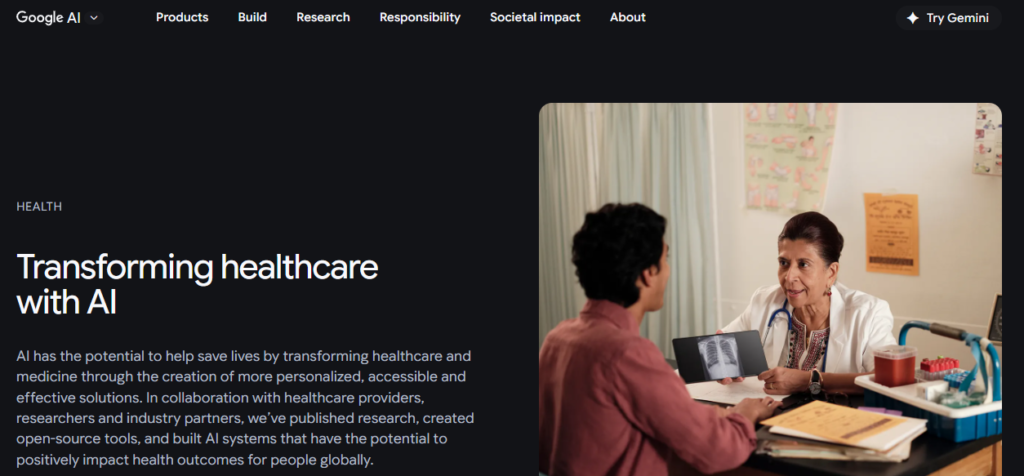
Focused on medical imaging research and deployment, particularly in areas like radiology and ophthalmology. Google Health AI tools are designed to assist clinicians and are validated in clinical settings.
Best for:
- CT scans, MRI, and X-ray analysis
- Faster diagnosis support
- Reduced diagnostic delays
Portable & Point-of-Care Imaging
These AI tools for healthcare bring imaging closer to the patient, especially in emergency and remote settings.
Butterfly iQ
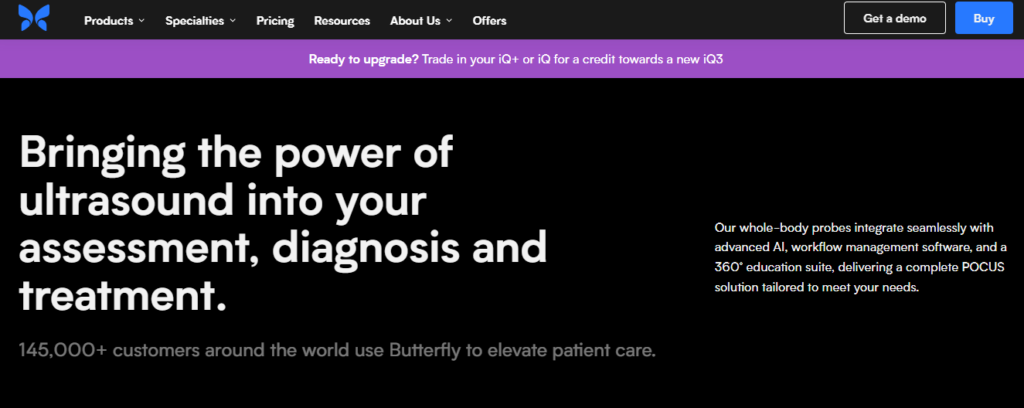
Butterfly iQ AI: A handheld ultrasound device App powered by AI. It connects to a smartphone and is used at the bedside to support fast assessments in emergency rooms and clinics.
Caption Health
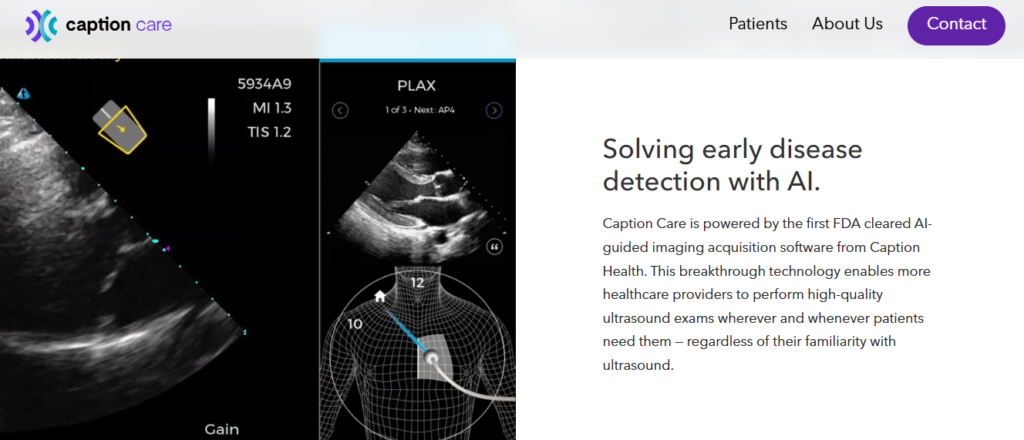
Helps non-expert users capture diagnostic-quality ultrasound images. The Caption Health AI guides users in real time, making point-of-care imaging more accessible without lowering standards.
Best for:
- Bedside imaging
- Faster assessments
- Expanding access in low-resource settings
Virtual Assistants & Patient Triage
These tools support early-stage patient interaction and symptom assessment.
Ada Health
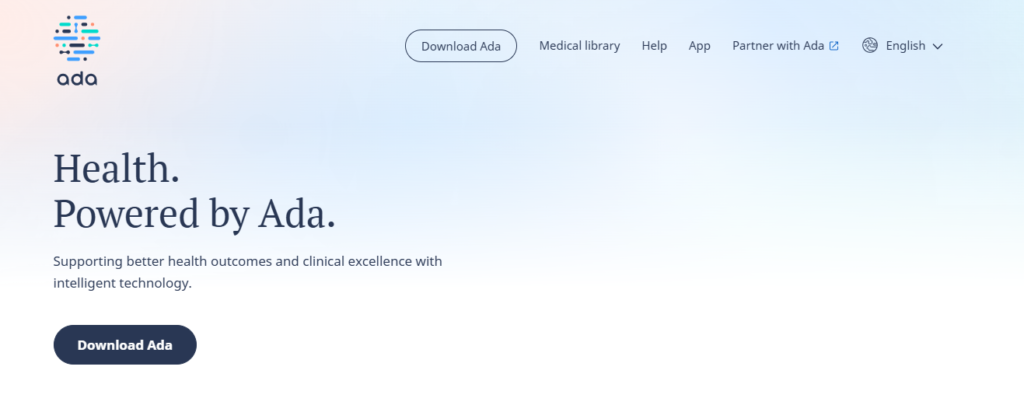
Ada Health AI: Used by healthcare providers and patients for symptom checking and guidance. It helps direct people to appropriate care paths while reducing unnecessary visits.
Buoy Health
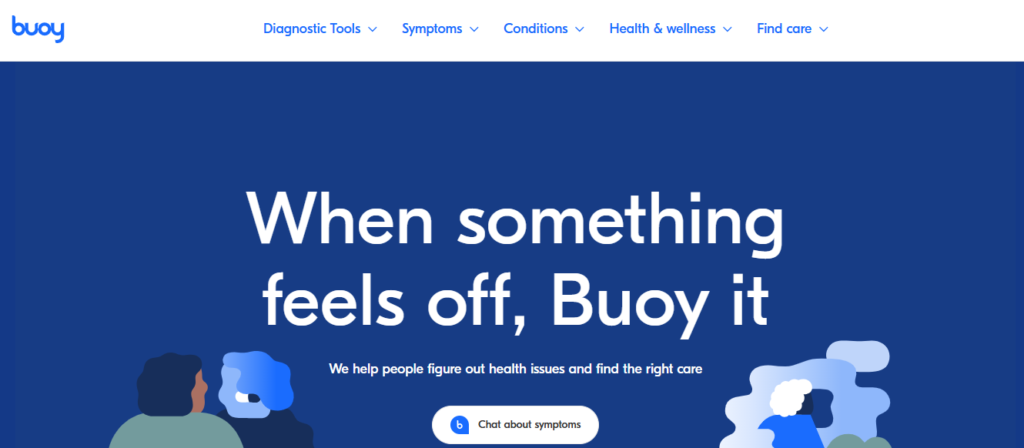
Buoy Health AI: Focuses on patient triage and navigation. Buoy helps healthcare systems manage demand by guiding patients to the right level of care.
Mediktor
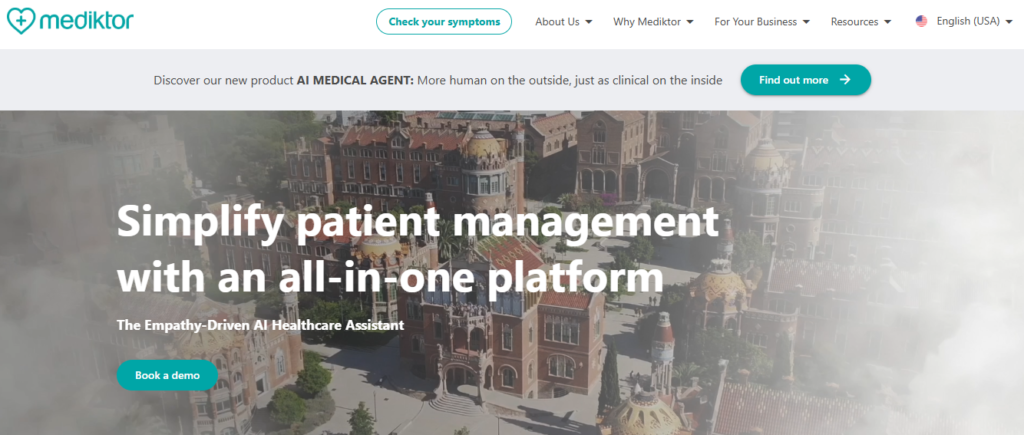
Mediktor AI: An AI-powered symptom assessment tool used in clinical and pre-clinical settings. It supports patient intake and prioritization without making diagnoses.
Best for:
- First-touch patient interaction
- Reducing triage workload
- Improving patient flow
Clinical Documentation & Administrative AI
These tools reduce paperwork. One of the biggest pain points in healthcare.
Nuance Dragon Medical One / DAX Copilot
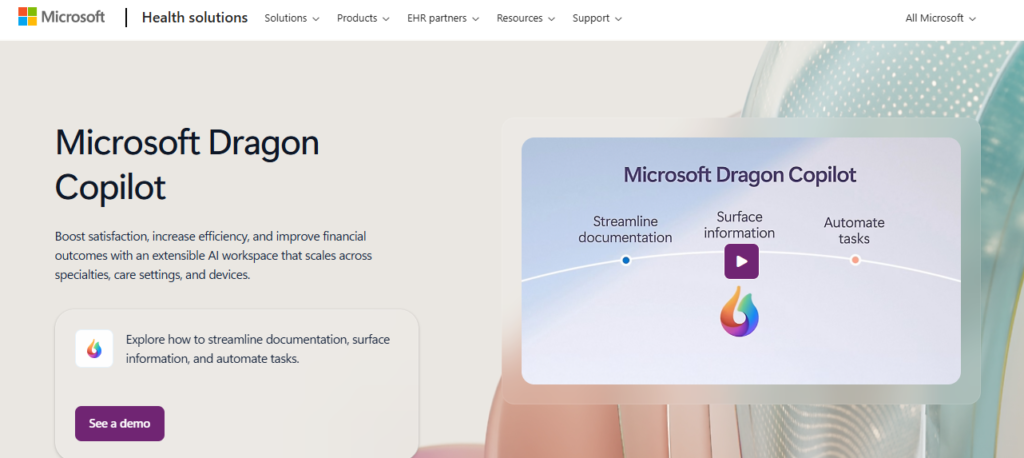
Nuance Dragon Medical One: Used daily by healthcare specialists to create clinical notes through voice and ambient listening. It integrates with EHRs and significantly cuts documentation time while keeping clinicians in control.
Apache cTAKES
An open-source NLP AI system built for healthcare. It extracts insights from clinical notes and supports research, analytics, and clinical workflows.
Honey Health AI
Focuses on automating administrative tasks and summarizing clinical interactions, helping teams spend less time on manual data entry.
Best for:
- Clinical notes
- Reducing admin workload
- Improving documentation accuracy
Data Management & Healthcare Analytics
This AI tool helps healthcare systems turn data into usable insight.
LizAI XT
Designed to help clinicians and organizations analyze health data in real time. It focuses on summarization, insights, and decision support without overwhelming users.
Best for:
- Healthcare analytics
- Operational insights
- Managing large-scale patient data
Note: These AI tools for healthcare are mentioned as per market analysis and performance test by experts. Humans always make the final decision after checking complete reports for errors. Through proper research and findings, these AI tools are considered the best in the present healthcare market.
Is There a Medical Version of ChatGPT?
This is one of the most searched and misunderstood questions in healthcare AI. Let me give you a clear answer: No public chatbot is a “medical ChatGPT.”
Healthcare systems don’t use consumer AI tools the way individuals do, and there’s a good reason for that.
Is ChatGPT HIPAA-Compliant?
Public ChatGPT is not built for clinical use, because:
- It is not designed to handle protected health information (PHI)
- Conversations are not structured for medical record storage
- It does not meet healthcare compliance requirements by default
That doesn’t mean AI language models have no place in healthcare. It means public versions are not approved tools for patient data.
Healthcare organizations require:
- Controlled data environments
- Clear audit trails
- Formal security and compliance validation
Public chatbots don’t meet those standards.
Why Hospitals Don’t Use Consumer Chatbots
Hospitals are careful by necessity. Even small risks can have real consequences for patient care and trust. Why consumer AI tools stay out of clinical workflows, because:
Data privacy risks
Patient data cannot be exposed to external, non-compliant systems.
No clinical validation
Medical AI tools must be tested against real clinical outcomes. Consumer chatbots aren’t.
No regulatory clearance
Hospitals rely on tools that meet healthcare regulations and internal governance rules.
In short, healthcare teams don’t need “smart chat.” They need safe, verified, task-specific AI healthcare solutions.
Best Medical AI & ChatGPT Alternatives Used in Healthcare
So what do healthcare organizations actually use instead? They rely on clinical-grade AI tools built specifically for healthcare environments.
Clinical-Grade NLP Systems
These tools use natural language processing to work with clinical notes, reports, and patient data inside secure systems.
- Designed for healthcare data structures
- Integrated with EHRs
- Trained on medical language, not internet text
Examples include clinical documentation platforms and research-focused NLP systems used in hospitals and life sciences.
Regulated Documentation AI
Instead of open chatbots, clinicians use AI tools that:
- Transcribe and structure clinical notes
- Reduce documentation errors
- Operate within approved healthcare systems
These tools support clinicians in real time while keeping complete human oversight.
Triage and Diagnostic Support Platforms
Healthcare AI tools in this category:
- Assist with symptom assessment
- Help prioritize patient care
- Support decision-making without replacing clinicians
They are validated, monitored, and designed to improve patient care, not to give standalone medical advice.
Custom Enterprise AI in Secure Environments
Large healthcare organizations often deploy AI models inside their own infrastructure. These systems:
- Never expose patient data externally
- Use artificial intelligence tools trained on approved health data
- Support analytics, forecasting, and operational planning
This approach gives healthcare teams control over how AI models work, where data lives, and how outcomes are measured.
The Bottom Line for Healthcare Teams
Hospitals do not use a publicly available medical version of ChatGPT. Instead, healthcare providers depend on AI tools designed specifically for medical purposes, emphasizing task-specific functions, robust data security, and genuine clinical benefits. In the healthcare sector, safety is prioritized over convenience, and that remains constant.
HIPAA, Safety & Compliance: What AI Tools Must Meet
In healthcare, AI tools don’t get adopted because they sound impressive. They get adopted because they meet strict safety and compliance rules. This is non-negotiable because the healthcare industry has some standards.
HIPAA & GDPR Compliance
Any AI tool used in healthcare must protect patient data at every step. That means:
- Patient data stays encrypted
- Access is restricted and logged
- Data use follows HIPAA and, where applicable, GDPR rules
If a tool can’t clearly explain how it protects health data, it doesn’t belong in a clinical setting.
FDA or CE Clearance (When Required)
Some AI tools go beyond support and influence medical decisions. In those cases:
- Regulatory clearance is required
- Tools must show clinical validation
- Performance must be reviewed over time
Hospitals don’t depend on tools that bypass this step, particularly for imaging or diagnostic assistance.
Audit Trails and Explainability
Healthcare teams need to know:
- What the AI did
- Why did it make a recommendation
- Which data was used
Clear audit trails help clinicians trust the system and catch errors early. Explainability isn’t a bonus feature. It’s a safety requirement.
Human Oversight Is Mandatory
AI tools support care, but humans stay in control. Clinicians:
- Review outputs
- Make final decisions
- Are accountable for patient care
What Is the Most Common Use of AI in Healthcare?
If you strip away the hype, AI in healthcare is mostly used in very practical ways. The most common applications focus on saving time and reducing errors, not replacing clinicians.
Clinical Documentation Automation
This is the leading use case today. AI helps:
- Capture clinical notes accurately
- Reduce manual typing
- Organize patient data inside EHR systems
Clinicians spend less time on paperwork and more time with patients.
Medical Imaging Interpretation
AI tools support radiologists by:
- Flagging urgent findings
- Prioritizing scans
- Reducing review time
The final diagnosis remains human-led, but AI improves speed and consistency.
Risk Prediction & Early Detection
AI analyzes large volumes of health data to:
- Identify risk patterns
- Flag early warning signs
- Support proactive care decisions
This is especially useful in chronic disease management.
Administrative Workflow Optimization
Healthcare systems also use AI to:
- Schedule patients
- Manage resources
- Reduce operational delays
These behind-the-scenes improvements directly impact patient care.
What are the Key Applications of AI in Healthcare
AI tools are now embedded across multiple areas of care, each with a specific role. It’s not that doctors or clinicians cannot do what AI does. It’s about increasing productivity, managing time and the number of patients checked with technology.
The following are the services in healthcare where AI is prevailing:
Early Disease Detection
By analyzing patient data, lab results, and imaging, AI helps surface signals that might be missed in busy clinical environments.
Predictive Analytics
AI models support:
- Readmission risk forecasting
- Treatment outcome prediction
- Population health analysis
These insights help healthcare organizations plan more effectively.
Remote Patient Monitoring
AI supports real-time monitoring through connected devices. This allows care teams to:
- Track patient status remotely
- Respond faster to changes
- Reduce unnecessary hospital visits
Virtual Patient Support
AI-powered systems assist with:
- Symptom guidance
- Appointment preparation
- Basic patient education
These tools improve access while keeping clinical decisions human-led.
Personalized Treatment Planning
By analyzing health data, AI helps clinicians:
- Compare treatment options
- Consider patient-specific factors
- Support more tailored care decisions
It’s guidance, not automation. It’s a real help that AI technology brings to the healthcare industry
Benefits of AI Tools in Healthcare
When used correctly, AI tools bring measurable benefits. Healthcare teams see:
- Reduced administrative burden
- Faster access to critical insights
- More consistent workflows
- Better use of limited clinical resources
Most importantly, clinicians regain time and patients receive more focused care. AI doesn’t change the goal of healthcare. It helps teams reach that goal more safely and efficiently.
Limitations & Ethical Concerns for AI Tools in Healthcare
AI helps healthcare, but it is not perfect. Anyone saying otherwise hasn’t worked with it in clinical settings. Let’s be honest about where things can go wrong.
Data Privacy Is a Real Risk
Healthcare data is deeply personal. If AI tools are not built for healthcare:
- Patient data can leak
- Systems can be misused
- Trust can be lost fast
This is why hospitals avoid general AI tools and focus on platforms designed specifically for handling health data.
Bias Comes From Bad Data
AI learns from past data. If that data is incomplete or uneven, the results are too. That can mean:
- Certain patient groups are underrepresented
- Risk predictions miss important signals
- Care decisions become less accurate
Better data matters more than smarter algorithms.
Too Much Automation Can Hurt Care
Automation saves time. But in healthcare, too much automation creates blind spots. When teams stop checking results:
- Errors slip through
- Context is lost
- Clinical judgment gets weaker
AI should assist clinicians, not replace careful thinking.
“Why Did the AI Say That?” Still Matters
Doctors need to understand recommendations. If an AI tool can’t explain itself:
- Clinicians don’t trust it
- Errors are harder to catch
- Adoption slows down
This is why explainability is becoming a basic requirement.
Medical Responsibility Stays Human
AI does not carry legal or ethical responsibility. Doctors do, Nurses do, and Healthcare teams do. AI can support decisions, but humans remain accountable, always.
How Healthcare Organizations Evaluate AI Tools
Hospitals don’t buy AI tools the way companies buy software. They move carefully, and for good reason.
Clinical Proof Comes First
Before anything else, teams ask:
- Has this been tested in real hospitals?
- Does it improve patient care?
- Are results backed by studies or real-world use?
If the answer is unclear, the tool usually stops there.
Regulatory Approval Is Non-Negotiable
Healthcare AI often needs:
- FDA approval
- CE marking
- Local regulatory clearance
Without this, tools don’t make it past evaluation.
It Must Work With Existing Systems
If an AI tool doesn’t fit into current healthcare systems:
- Clinicians won’t use it
- Workflows encounter failures.
- Training becomes harder
EHR compatibility matters more than fancy features.
Strong Data Controls Are Required
Hospitals check:
- Who can access data
- How data is stored
- Whether actions are logged and traceable
Clear controls protect both patients and staff.
Real Performance Matters More Than Demos
A polished demo means nothing if the tool:
- Slows teams down
- Creates extra work
- Fails under daily pressure
Healthcare teams care about what works on a busy shift, not in a presentation.
Future of AI Tools in Healthcare (2026-2030)
AI tools in healthcare will integrate into daily systems rather than functioning as standalone software. They will assist doctors in real time by providing patient data, highlighting risks early, and minimizing documentation tasks.
AI decisions will need to be explainable, regulated, and reviewed by humans. Natural language processing will expand across clinical notes and records, while remote monitoring tools will grow for chronic care and follow-ups.
The future of AI Tools is to support healthcare professionals and work alongside them. The motive is to provide help, making their jobs easier and more effective. It’s all about teamwork!
Daily AI Tools Final Verdict
AI tools don’t replace doctors or nurses. They reduce friction. When used well, they help healthcare teams handle data faster, spot risks earlier, and spend more time on patient care instead of screens.
The tools that actually work in healthcare are purpose-built, regulated, and used with human oversight. General-purpose AI has a role in support tasks, but clinical decisions must always stay with trained professionals.
Daily AI Tools’ view: AI becomes most helpful in healthcare when it’s safe, transparent, and meant to assist. When used like this, AI can truly enhance care while maintaining trust and confidence.
FAQs
What AI tools are used in healthcare?
What is the most common use of AI in healthcare?
Is there a medical version of ChatGPT used by hospitals?
Is ChatGPT HIPAA-compliant for healthcare use?
What are the main types of AI tools used in healthcare?
clinical documentation AI
medical imaging and diagnostics
patient triage systems
healthcare data analytics platform
Each supporting care delivery is under human control.