AI didn’t suddenly change digital marketing. It crept in quietly. Besides, AI tools are available for almost every digital activity in today’s world. AI in Digital Marketing continues to bring promising changes.
First through ad platforms. Then email tools. Then analytics dashboards and content systems. By 2026, most businesses will use artificial intelligence in marketing without even labelling it as “AI.”
They use it because it works. AI-powered marketing tools are the game-changer that quickly leads to ROI of choice.
AI helps marketers understand what people do, react faster to changes, and improve results. It doesn’t replace experience or strategy. This guide reflects how AI is being used in digital marketing heading into 2026, based on current tools, workflows, and real-world usage patterns.
What Is AI in Digital Marketing?
AI in digital marketing involves using artificial intelligence technologies. Machine learning and natural language processing help analyze customer behavior, automatically adjust marketing strategies, and enhance campaigns in real time.
The difference from traditional automation is simple. Automation follows instructions & AI learns from outcomes.
When user behavior shifts, AI adapts. It notices patterns, tests changes, and improves performance over time. That’s why it fits modern digital marketing, where audiences and platforms change constantly.
How AI Works in Digital Marketing
AI in marketing sounds complex until you look at how it actually works. However, the AI platforms or tools are designed to increase productivity without complexity. But many users think that it is a hard job.
AI in digital marketing sounds complex until you look at how AI works in the broader context of modern technology. AI works in a very simple flow. In practice, it follows a basic loop:
observe → learn → respond.
Whatever tasks you are going to perform. This loop runs continuously in the background as new data comes in. The following are the technical representations of the AI working:
Data Collection and Behavioural Analytics
AI tools are designed to learn how users behave. There are no assumptions like real humans, nor are the actions. In easy words, AI learns from user behavior first, then applies those patterns consistently at scale. This is where automation becomes effective.
The AI models are the real players that collect signals such as:
- How visitors move through pages
- What content gets ignored or engaged with
- When users drop off or convert
- How campaigns perform across channels
This data builds a picture of intent. Over time, AI understands what attracts attention, what causes friction, and what leads to results.
Machine Learning and Predictive Analytics
Once enough behavior data exists, machine learning looks for patterns. Some users respond quickly. Others need follow-ups. Some disengage early.
AI recognises these differences without manual rules. That’s where prediction comes in.
Marketers can:
- Anticipate conversions before campaigns finish
- Identify churn risk earlier
- Adjust targeting and messaging before performance drops
Predictive analytics helps teams stay ahead instead of reacting late.
Generative AI and Content Intelligence
Generative AI is often misunderstood as “content writing.” In digital marketing, its fundamental role is content adjustment.
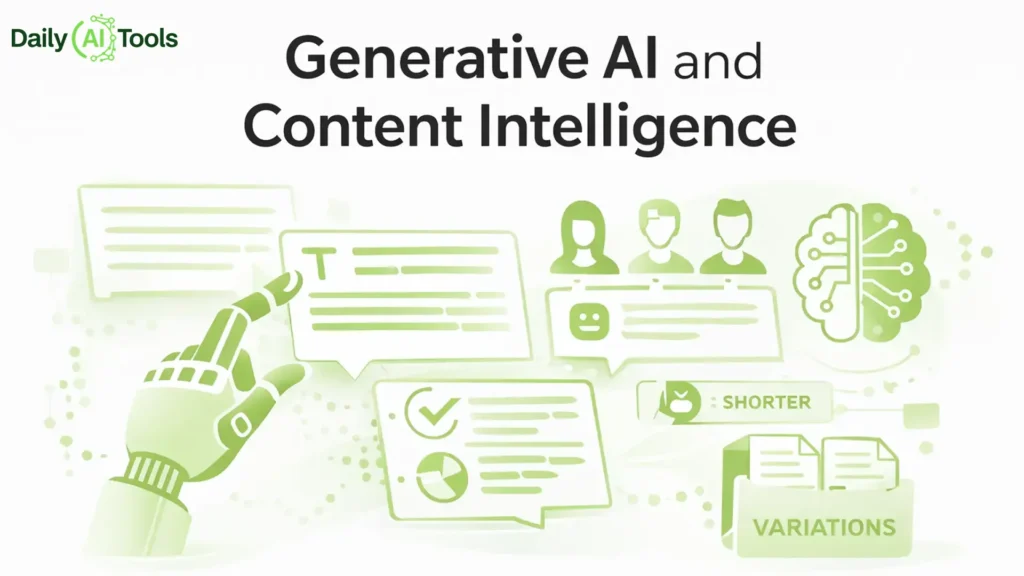
AI helps by:
- Adapting content to different audience segments
- Changing tone or length based on engagement
- Creating variations at scale without losing relevance
Strategy still belongs to humans. AI supports execution, not judgment. When used well, it improves consistency and speed. When overused, it creates generic output. The balance matters.
Why AI Matters in Digital Marketing Today
A few years ago, AI in marketing felt optional. Something teams experimented with on the side. That’s no longer the case.
In 2026, AI is built into how digital marketing actually runs. Not because it’s impressive, but because the pace of marketing has outgrown manual control.
Campaigns don’t wait for weekly reviews anymore. Audiences shift quickly. Platforms change their rules without warning. AI helps teams keep up when human attention alone isn’t enough.
Most marketers don’t use AI to be “smarter.” They use it to be faster without losing control.
It handles repetitive decisions like adjusting bids, sorting audiences, and rotating content. From this, people can focus on direction, messaging, and judgment. This is especially noticeable in teams running large or always-on campaigns, where manual optimization simply doesn’t scale.
AI-powered marketing works best when it reduces friction, not when it tries to replace thinking. Outcomes still depend on how deliberately the tool is used.
This shift is most visible in teams managing high-volume or always-on campaigns, where manual optimization simply doesn’t hold up under daily workload pressure.
Real-World Performance: How AI in Digital Marketing Actually Holds Up
AI sounds flawless in product demos. Day-to-day use tells a more balanced story. When used across live campaigns rather than demos, AI shows predictable strengths and equally predictable limitations.
Speed vs accuracy
AI is fast. Sometimes faster than ideal. It can optimize bids, rotate content, and adjust targeting in seconds. Accuracy improves over time, but early outputs still benefit from review.
Where AI performs consistently
AI works best in structured, repeatable tasks:
- Ad optimization
- Audience segmentation
- Performance forecasting
- Content variation testing
These areas reward pattern recognition, which is exactly what machine learning does well.
Where human review remains essential
AI struggles with context that isn’t data-driven:
- Brand voice and tone
- Sensitive messaging
- Ethical or legal decisions
- Long-term positioning
These areas require judgment, not prediction.
Reliability under daily workloads
In longer workflows, AI remains stable when tasks are clearly defined. Problems usually appear when expectations are unclear or when oversight is removed entirely.
The practical truth is simple: AI improves efficiency. Humans protect meaning. Used together, they work. Used alone, neither is enough.
Key Applications of AI in Digital Marketing
AI earns its place in digital marketing for solving day-to-day problems. The strongest use cases all share one thing in common: they reduce effort without reducing control.
The following are the uses of AI in Digital Marketing:
AI for Content Creation & Content Generation
Content is one of the first areas where teams feel pressure to scale. Blogs, landing pages, ad copy, it adds up fast. AI helps by handling volume.
It’s commonly used to:
- Draft blog outlines and first versions
- Create variations for ads and landing pages
- Repurpose existing content into new formats
This allows teams to publish more consistently without burning out writers or marketers. The key is how AI is used. Most teams treat AI-generated content as a starting point, not a finished product.
The limit shows up when context matters. Brand voice, nuance, and originality still require human input. AI can support content creation, but quality control remains a human job.
AI in Social Media Marketing
Social media moves quickly, and manual posting doesn’t scale well across platforms. AI is often used to:
- Generate post ideas and captions
- Schedule content based on engagement patterns
- Detect trends early through performance signals
- Analyze which formats and topics drive interaction
Teams use AI to spot patterns in what they already do. This makes social media planning more responsive and less reactive.
AI works best here as an assistant. It helps surface insights, but humans still decide what fits the brand and audience.
AI in Email Marketing & Personalization
Email marketing benefits from precision, and that’s where AI quietly performs well. Common uses include:
- Testing subject lines at scale
- Optimizing send times based on user behavior
- Segmenting audiences by engagement and intent
Rather than sending the same message to everyone, AI helps tailor emails based on how people actually interact. This leads to better open rates and more relevant communication, without marketers building complex rule sets manually.
Personalization works when it feels natural. AI helps with that by reacting to behavior, not assumptions.
AI in SEO & Search Optimization
SEO has shifted from keyword placement to intent matching. AI fits naturally into that change. Teams use AI to:
- Research keywords and related search terms
- Optimize content structure and clarity
- Analyze SERP layouts and competing pages
- Map content to search intent rather than just keywords
AI speeds up analysis, but it doesn’t replace SEO judgment. Search behavior changes, and not every signal tells the full story. The strongest results come when AI insights are paired with human understanding of users.
AI in Paid Advertising & Conversion Optimization
Paid advertising generates large volumes of data quickly. AI helps make sense of it. It’s widely used for:
- Smart audience targeting
- Automated budget allocation
- Testing creative variations
- Improving conversion rates through pattern analysis
Instead of manual bid adjustments, AI responds to performance signals in real time. This is especially valuable in high-spend or fast-moving campaigns.
Still, AI performs best when goals are clear. Without direction, it optimizes for numbers, not outcomes. Human oversight keeps campaigns aligned with business intent. While there are thousands of applications, choosing the best AI tools in 2026 depends on your specific marketing goals and team size.
AI Tools Commonly Used in Digital Marketing
Comparison-Focused Table:
| AI Tool | Best For | Key Feature | Free Plan | Best Value For | User Level |
| ChatGPT | Content & planning | Generative AI + reasoning | Yes | Daily workflows | Beginner – Pro |
| Gemini | Research & analysis | Multimodal + Google integration | Yes | Data-heavy teams | Beginner – Pro |
| Jasper | Marketing copy | Brand-aligned content | Limited | Agencies | Intermediate |
| HubSpot AI | CRM & automation | AI-powered marketing ops | Limited | Growth teams | Intermediate |
| Surfer AI | SEO | Content optimization | No | SEO professionals | Advanced |
| Canva AI | Design | Visual content creation | Yes | Non-designers | Beginner |
Benefits of Using AI in Digital Marketing
Most people searching for this want one answer: What does AI actually help with? The following are the benefits that attract users to tend towards AI use.
AI improves customer experience
AI reacts to real behavior instead of showing the same message to everyone. Visitors see content aligned with their actions, timing, and interests, making marketing feel less forced, relevant, and more engaging.
AI enables personalization at scale
Manual personalization becomes unsustainable as audiences expand. AI enables marketers to:
- Adjust messaging across audience segments
- Tailor offers without building complex rules
- Maintain consistency across channels
With the power of AI, personalization becomes manageable instead of overwhelming.
AI supports real-time decision-making
Campaigns don’t pause while teams analyze reports. AI responds instantly by:
- Adjusting bids and targeting
- Rotating content variations
- Responding to performance changes as they happen
This reduces missed opportunities. With AI, you can make decisions that are more performance-oriented and take less time.
AI increases efficiency without linear cost growth
AI allows teams to handle more work without adding the same level of resources. Content, campaigns, and optimization scale without matching increases in time or headcount.
Limitations of AI in Digital Marketing (What It Can’t Do Well)
AI is helpful, but it is not independent thinking. Knowing its limits prevents misuse. The following are the limitations of AI in Digital Marketing:
Accuracy and Context Gaps
AI works with patterns, not understanding. It may:
- Miss nuance in messaging
- Misinterpret user intent
- Apply the wrong tone to sensitive topics
This is why review matters, especially for brand-facing content. Human proofreading or monitoring is needed to finalise things.
Over-Reliance and Automation Risks
Automation can create distance from decision-making. Problems appear when:
- Outputs aren’t reviewed
- Metrics matter more than meaning
- AI is trusted without questioning results
AI supports decisions. It shouldn’t replace them.
Ethical and Data Privacy Concerns
AI depends on user data. Without care, this creates risks such as:
- Misuse of personal information
- Loss of user trust
- Compliance issues
Ethical use requires clear boundaries and human responsibility
Who AI Marketing Is NOT Ideal For
AI is not the right fit in every case. It may not work well for:
- Brands that require strict creative control
- Highly regulated industries without proper oversight
- Teams expecting AI to replace strategy and planning
AI performs best when it assists skilled marketers, not when it’s left on autopilot.
How Businesses Are Using AI in Digital Marketing Today
Most businesses don’t “adopt AI” all at once. They apply it where pressure already exists, like on time, scale, or performance. Below are some AI use cases in different industries:
E-commerce Personalization
Online stores use AI to react to shopping behavior as it happens. Common uses include:
- Showing product recommendations based on browsing patterns
- Adjusting offers and pricing signals in real time
- Personalizing emails and on-site messages after visits
This helps stores increase conversion rates without manually managing thousands of product combinations.
SaaS Onboarding and Retention
For SaaS companies, growth depends on how quickly users see value. AI helps by:
- Personalizing onboarding flows based on user actions
- Identifying users at risk of churn
- Triggering messages when engagement drops
Instead of generic onboarding, users get guidance that matches how they actually use the product.
Marketing Agencies Scaling Campaigns
Agencies manage multiple clients, platforms, and budgets at once. Manual optimization doesn’t scale well. AI supports agencies by:
- Automating campaign adjustments across accounts
- Testing creatives and audiences faster
- Spotting performance trends early
This allows teams to focus more on strategy and less on repetitive execution.
Local Businesses Optimizing Ads and Content
Local businesses use AI in simpler, focused ways. Typical use cases include:
- Optimizing local ads based on search behavior
- Improving content visibility without deep SEO expertise
- Scheduling posts and responses more consistently
AI helps smaller teams stay competitive without large budgets or technical staff.
How to Implement AI in Digital Marketing (Step-by-Step)
Most failures with AI come from doing too much too fast. A steady approach works better. Below is a step-by-step guide to implement AI:
- Identify Workflow Bottlenecks
Begin where effort is high, and returns are low. Look for:
- Tasks that repeat often
- Decisions made manually from large data sets
- Areas where speed matters but time is limited
These are the best places for AI support.
- Choose Task-Specific AI Tools
Avoid general tools that promise everything. Instead, pick tools designed for:
- Content assistance
- Ad optimization
- Email personalization
- SEO analysis
A clear purpose leads to better results. You also save more when you choose a specific functionality AI tool.
- Start With Assisted Automation
Let AI assist before it acts independently.
Examples:
- Review AI-generated content before publishing
- Monitor automated bid changes
- Keep humans in the approval loop
This builds trust without losing control.
- Measure Impact Before Scaling
AI should prove value before expansion. You need to track:
- Time saved
- Performance changes
- Quality and consistency
Once results are clear, scale carefully.
Free vs Paid AI Tools for Digital Marketing
Most marketers start with free AI tools. That makes sense. Free access helps you understand how AI fits into your workflow before committing money.
Free AI tools are usually enough when:
- Your usage is occasional, not daily
- Output volume is low and manageable
- You’re still exploring where AI adds value
For basic content help, light research, or testing ideas, free plans often cover what you need.
Paid AI tools start to make sense when AI becomes part of real work. They’re worth it when:
- AI supports daily operations, not experiments
- Output consistency matters across campaigns
- Speed, reliability, and limits affect results
- The return clearly outweighs the cost
In most cases, the move from free to paid happens naturally. Once AI saves time or improves performance, paying for stability becomes practical, not optional.
Is AI Replacing Digital Marketers?
Short answer: No. AI is not replacing digital marketers. It’s changing how they work.
AI handles repetitive tasks like data analysis, content variation, and optimization. Humans remain responsible for strategy, creativity, ethical judgment, and decision-making.
Marketers who understand AI gain leverage. Those who ignore it lose efficiency. AI works best as a tool in skilled hands, not as a replacement for them.
Future of AI in Digital Marketing (2026 and Beyond)
AI in digital marketing is moving out of the “tool phase” and into the core of how teams work. Businesses are using AI, which removes friction, saves time, and improves decisions without taking control away from humans. In 2026, four things are clear for Future of AI:
Personalization Becomes Standard, Not Special
By 2026, personalized marketing won’t feel advanced. AI will adjust content, offers, and timing based on real behavior, not static segments. Customers won’t see “targeted ads.” They’ll see messages that simply feel relevant. Brands that can’t do this will feel out of sync.
Prediction Replaces Reaction
Marketing teams are moving from reports to foresight. AI will increasingly predict outcomes like who’s likely to convert, disengage, or respond, before campaigns end. This allows teams to act early, not explain results later. Strategy becomes proactive instead of reactive.
Fewer Platforms, Smarter Systems
The future is fewer AI tools with better connections. Data, content, and performance signals will live in tighter systems that reduce manual switching and duplicated work. AI will sit inside workflows, not on top of them.
Human-AI Collaboration Wins
Full automation sounds efficient, but it rarely works in real marketing environments. The winning model is collaboration. AI handles scale, speed, and analysis. Humans handle judgment, creativity, and direction. Brands that see AI as a partner rather than a replacement will move faster, remain competitive, and credible.
In simple terms, AI won’t run marketing. It will support it. The advantage won’t come from using more AI, but from using it with intent, restraint, and human oversight.
FAQs
What is AI in digital marketing?
AI in digital marketing refers to using artificial intelligence technologies like machine learning and natural language processing to analyze user behavior, automate decisions, and improve marketing performance. Unlike traditional automation, AI adapts based on outcomes, helping campaigns improve continuously without manual rule-setting.
How does AI work in digital marketing?
AI in digital marketing works through a continuous loop of data collection, learning, and response. It analyzes user behavior, identifies patterns through machine learning, and adjusts actions like targeting, content, or timing in real time to improve performance without manual intervention.
How is AI used in digital marketing today?
Today, AI is used for content personalization, ad optimization, audience segmentation, SEO analysis, email timing, and performance forecasting. Most businesses use AI quietly inside existing tools to handle repetitive decisions faster while marketers focus on strategy and creative direction.
Can AI be used in digital marketing without technical skills?
Yes, most AI marketing tools are designed for non-technical users. Marketers can use AI for content creation, ad optimization, email personalization, and analytics through simple interfaces. Technical skills are only needed for advanced customization, not for everyday AI-driven marketing tasks.
How do companies use AI in digital marketing to increase ROI?
Companies use AI to improve ROI by optimizing ads in real time, personalizing customer experiences, predicting conversion behavior, and reducing manual workload. AI helps teams react faster to performance changes, allocate budgets more efficiently, and scale campaigns without increasing costs linearly.