Discover, Compare & Master Find the best AI tools for your next project in seconds. Check our latest AI insights

DataRobot

Verified

DataRobot is an enterprise AI platform for predictive AI, GenAI, deployment, monitoring, & governance for large teams & production workflows.

4.6/5 editorial rating 684 upvotes
  • Main category: business
  • Subcategory: AI Analytics Assistant
  • Pricing: Custom Pricing
  • Web
  • Best For Enterprise teams that need one platform for predictive AI, generative AI, deployment, monitoring, and governance across production workflows.
  • Free Trial Yes
  • Reviewed By Waleed Fayyaz
  • Last Updated April 21, 2026

Editorial note: ratings and verdicts on this page are internal editorial assessments, not third-party user review averages.

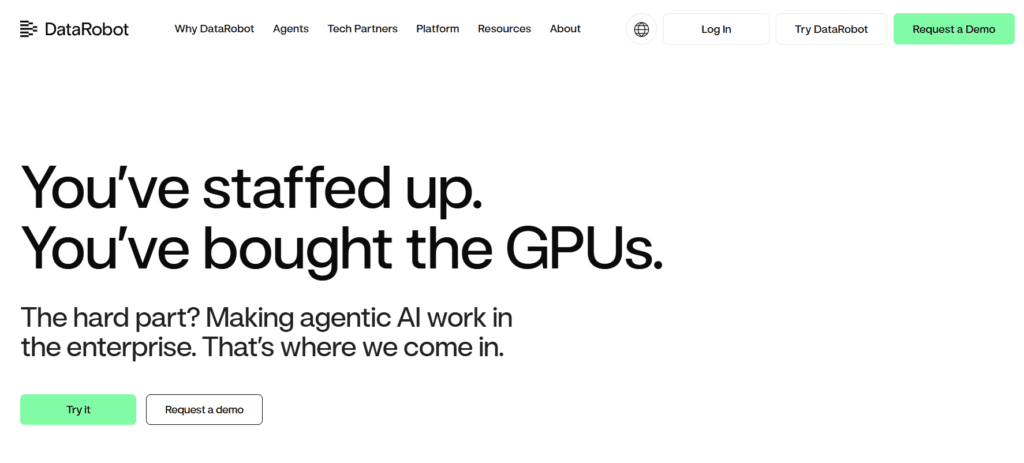
DataRobot | Unified Agent Workforce Platform for Enterprise

DataRobot Verdict

DataRobot justifies its cost when a company needs model building, deployment, monitoring, governance, and GenAI tooling in one enterprise system. It is less suitable for buyers who need a low-cost self-serve point solution. The product fits data science, ML engineering, analytics, and governance teams that run AI in production and need control over models, agents, infrastructure, and compliance workflows.

What Is DataRobot?

DataRobot is an enterprise AI platform. Its public documentation covers predictive AI, generative AI, agent development, model registry, deployment, and monitoring. It is positioned as a unified system for teams that build, operate, and govern AI applications and agents.
On the predictive side, DataRobot supports model creation through its platform and REST API. On the generative side, its GenAI service supports managed LLM providers such as Azure OpenAI, Amazon Bedrock, Google Vertex AI, Anthropic, Cerebras, and TogetherAI. Public docs also show support for embeddings and provider configuration, but DataRobot does not publicly disclose every underlying model used in each customer workflow.
In professional workflows, DataRobot fits organizations that need web access plus code-first access through APIs, notebooks, and CLI tooling. It also supports registry, deployment, and monitoring workflows, plus integrations with infrastructure and framework tools such as AWS, Azure, Google Cloud, Databricks, Snowflake, SAP, LangChain, Pinecone, Chroma, Apache Airflow, MLflow, and GitHub. That makes it practical for teams moving models and GenAI systems from experimentation into governed production environments.

Review Summary

  • Performance Score A
  • Content Quality Output quality depends on project setup, selected models, and evaluation design, but the platform includes testing, monitoring, and production controls for both predictive and generative workflows.
  • Interface The product offers a web interface with broad feature coverage, but DataRobot fully supports only the latest version of Google Chrome for the best experience.
  • Ai Technology Predictive AI, Generative AI, LLM orchestration, embeddings, model registry, and MLOps.
  • Purpose Its main objective is to help enterprises build, deploy, monitor, and govern AI systems in one platform.
  • Compatibility Latest Google Chrome, web application, REST API, notebooks, CLI, and integrations with AWS, Azure, Google Cloud, Databricks, Snowflake, SAP, LangChain, Pinecone, Chroma, Apache Airflow, MLflow, and GitHub.
  • Pricing Summary DataRobot uses enterprise sales-led pricing, and it also offers a one-time 30-day free trial for its self-service SaaS environment.

DataRobot Key Features

  • 1

    Predictive AI workflows

  • 2

    Generative AI service

  • 3

    LLM provider support

  • 4

    Model Registry

  • 5

    Deployment monitoring

  • 6

    REST API access

  • 7

    Notebook workflows

  • 8

    Framework and data platform integrations

Who Should Use DataRobot?

Is DataRobot Worth It?

DataRobot is a paid product, so value depends on whether its features, performance, and workflow justify the cost.

Pros And Cons

Pros

  • Combines predictive AI, GenAI, deployment, and governance in one product.
  • Supports both web-based and code-first workflows through API, notebooks, and CLI.
  • Includes registry and deployment controls for DataRobot, custom, and external models.
  • Connects with common cloud, data, and framework tools used in enterprise stacks.

Cons

  • Public pricing is not listed, so early budget comparison is limited.
  • The product scope is broad, which can increase onboarding and evaluation time.
  • Chrome is the only fully supported browser.
  • Trial users get batch predictions only, not full production prediction access.

DataRobot Pricing

Free

$0

  • self-service SaaS access,
  • with full platform access,
  • shared modeling workers,
  • batch predictions, and trial-specific GenAI access.

Enterprise

Custom pricing

  • sold through DataRobot sales.

Frequently Asked Questions