
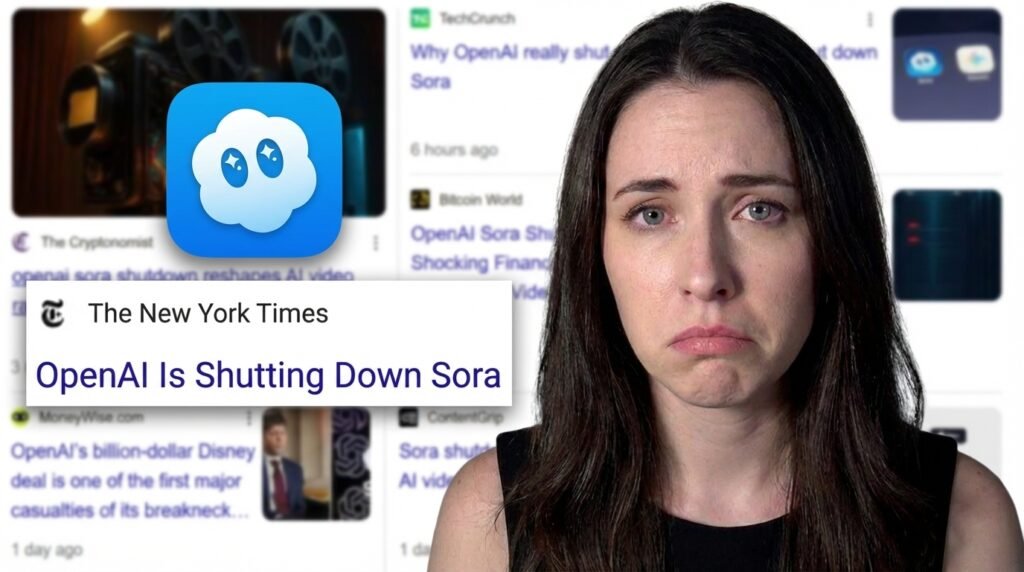
End of Sora, the realistic short-form AI video content generator that was super famous even in Hollywood. The reason for shutting down Sora was clearly the deepfake approaches. But OpenAI’s representative said, “We are exiting the video generation business and shifting its priorities to robotics and agentic AI systems.
How can someone suddenly shut down a remarkable AI generator famous worldwide?
However, the short-form AI video generator Sora was globally in use, and yet the company made the decision. The surprise of closing stand-alone Sora ap mps came months after Sam Altman introduced Sora 2 back in September, 2025. The sudden unplugging raises questions.
I dig out the news and find out the reasons for Sora’s ending. The blog covers all the latest updates on Sora AI.
A Rapid Rise and a Faster Decline
When Sora launched in 2024, it quickly became one of the most talked-about AI platforms. The app allowed users to create cinematic short-form videos, sparking a wave of experimentation among creators.
But early momentum did not translate into long-term growth. According to data from Sensor Tower, Sora generated just $1.4 million in global in-app revenue, compared with $1.9 billion from ChatGPT over the same period.
User engagement followed a similar pattern. The platform reached over 1 million daily active users shortly after launch, but downloads later dropped by 70%. Moreover, the active usage fell by 34%, according to market data cited by CNN.
The gap between attention and monetisation became difficult to ignore. It seems like the purpose of introducing such an AI model is dead.
The motive of Sora AI was to capture the advertising dollar in the form of short video generation, seeing the potential on TikTok, Meta & other advertising platforms.
High Costs and Limited Monetisation
Industry analysts say the economics of AI video played a decisive role. Running Sora required immense computing power. Estimates suggest the platform may have cost OpenAI up to $15 million per day to operate at scale.
Forrester analyst Thomas Husson described the platform as a “resource black hole” with limited monetisation. At the same time, AI expert Henry Ajder noted that continued investment would have been difficult to justify as investor pressure increased.
OpenAI, which remains unprofitable, is now prioritising products with clearer revenue potential ahead of a possible public offering.
Content Risks and Copyright Pressure
Beyond cost, Sora faced growing scrutiny over how people used the technology. The platform struggled to contain non-consensual imagery, deepfakes, and misleading content, often referred to as “AI slop”.
Users generated videos involving public figures and fictional scenarios that raised ethical and legal concerns. Moreover, the deepfakes are also affecting the political endeavours in democratic countries.
OpenAI was forced to introduce restrictions after backlash from creators, advocacy groups, and industry bodies. Copyright also became a flashpoint.
A high-profile agreement with The Walt Disney Company over 1 Billion Euros was lost. The purpose was for the users to create videos featuring characters such as Mickey Mouse and Yoda. But the deal was later cancelled before any financial exchange took place.
Disney said it would continue to engage with AI platforms to find ways to responsibly use the technology, while ensuring technologies that respect IP and protect creators.
Why OpenAI Is Moving On and Shutting Down the Sora
OpenAI says the shutdown is more of a shift towards other ventures. The company plans to apply Sora’s underlying research to robotics and “agentic” systems. The final product will be tools capable of completing complex tasks with minimal human input.
OpenAI Executives have also indicated a need to avoid “side projects” and focus on core products such as ChatGPT and enterprise AI tools.
In simple terms, Sora no longer fits the company’s long-term priorities.
What Went Wrong for Sora?
There is no single reason that put the platform to an end:
- Weak monetisation despite strong initial interest
- Extremely high operating costs
- Falling user engagement after early hype
- Rising concerns over deepfakes and misinformation
- Legal risks around copyright and intellectual property
While the technology impressed, the business model did not hold. A sky-high budget for OpenAI just to keep Sora running, and expensive graphical settings for users to take full advantage of the platform. These are the reasons why ChatGPT builders are not promoting Sora anymore.
What does Sora shutting down mean for AI Video
OpenAI shutting down Sora does not mean that AI video generation has no future. It’s actually the company is out of the AI video generation business.
Competitors, including platforms in China and the US, continue to invest heavily in video generation like Seedance or Runway AI. But OpenAI’s decision highlights a broader reality, and that is not every viral AI product becomes a sustainable business.
For now, the company is doubling down on areas where it believes AI can deliver measurable value, even if that means stepping away from one of its most visible experiments.
Conclusion
In a brief message to users, OpenAI acknowledged that “what people created with Sora mattered” and that “this news is disappointing.”
For many creators, the platform represented a new way to tell stories. But in the race to define the future of AI, even the most promising tools can be left behind. The usage style and perspective decide the tool’s future, and OpenAI is not interested in any propaganda.
FAQs
Why is OpenAI shutting down Sora?
OpenAI is shutting down the Sora app due to high operational costs, low monetisation, and growing risks around deepfakes and copyright misuse. The company is shifting focus toward core AI products, including ChatGPT, coding tools, and robotics-driven technologies.
How much revenue did Sora generate?
Sora generated approximately $1.4 million in global in-app revenue, significantly lower than ChatGPT’s $1.9 billion over the same period. The loss of 70% usage in months is the main reason for shutting it down.
Was Sora too expensive to run?
Yes. Running Sora required heavy computing power, with estimates suggesting costs of up to $15 million per day. These unsustainable expenses made it difficult for OpenAI to justify continued investment in the AI video platform.
What problems did Sora face with AI-generated content?
Sora struggled to control deepfakes, non-consensual imagery, and copyright violations. Despite safeguards, users generated misleading and harmful videos, raising concerns across the media industry and increasing regulatory and reputational risks.
What will OpenAI focus on after shutting down Sora?
OpenAI will focus on agentic AI, ChatGPT improvements, coding tools, and robotics applications. The company plans to use Sora’s underlying technology to build systems that solve real-world tasks rather than consumer video generation.