
Ethics in AI is about making sure artificial intelligence (AI) is built and used in ways that respect people, protect rights, and avoid harm. It sets the rules for how AI technology should make decisions, use data, and interact with human intelligence, especially when those decisions affect real lives.
Ethics matters now because AI systems are applicable in many industries. They approve loans, screen job applicants, detect fraud, write content, and guide public services. When these systems scale without clear boundaries, ethical issues like bias, privacy loss, and unsafe automation grow fast.
This guide is for developers, business leaders, policymakers, and private sector teams who need practical clarity. It explains the principles of AI ethics, real risks, current AI regulations, and how responsible AI development works in 2026. Also, learn examples you can trust and apply.
What Is Ethics in AI?
Ethics in AI is the practice of designing and using AI systems that are fair, transparent, safe, and accountable to humans.
It guides how AI algorithms, machine learning models, and AI modeling processes are designed, trained, and used so they do not cause harm or unfair outcomes.
In simple terms, ethics in AI exists to ensure that AI systems help people, not replace their decisions or amplify existing problems.
Why Ethics in AI Matters
AI is now making decisions that once required human intelligence, and that’s where the real risk begins. When ethics are absent, the harm is tangible. It manifests in rejected loans, unfair hiring practices, broken trust, and unsafe automation.
The following are the real ethical issues organizations face today:
Bias in AI algorithms
AI learns from past data. If that data is biased, the system repeats and scales the same mistakes, often invisibly.
Privacy loss from AI modeling
Many AI systems collect and analyze personal data without clear consent, creating long-term risks for individuals.
Automated decisions without accountability
When AI makes a mistake, people often can’t tell who is responsible: the developer, the company, or the system itself.
Generative AI misuse
AI can now create fake content, voices, and images that are hard to detect, increasing fraud and misinformation risks.
High-risk AI systems in healthcare, finance, and law
Errors in these areas can directly affect lives, freedom, and financial security.
Ethics in AI exists to prevent these failures before they scale, not after damage is done.
What are the 5 Core Principles of Ethical AI?
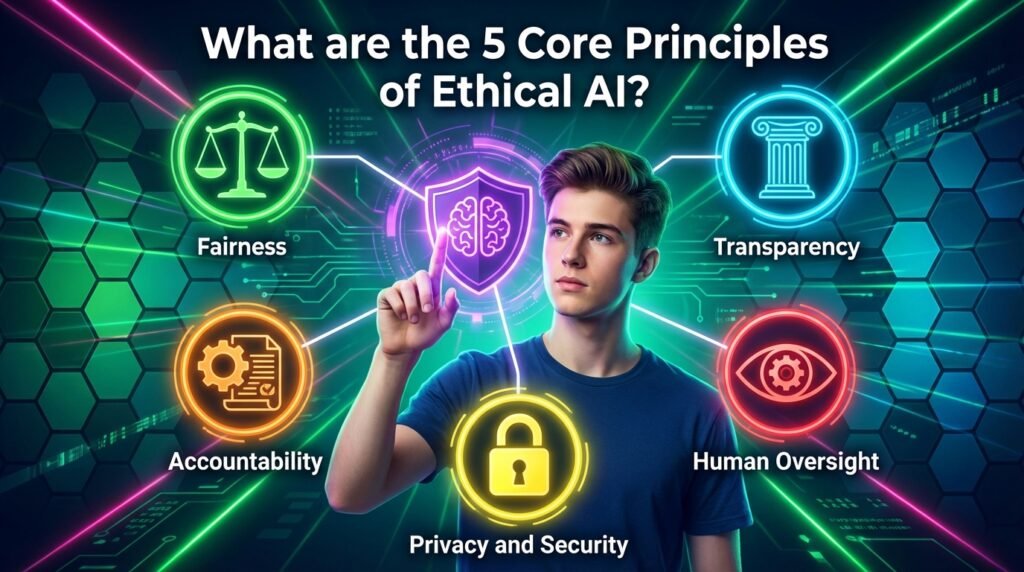
Ethical AI is built on fairness, transparency, accountability, privacy, and human oversight to ensure AI systems support people without causing hidden harm.
Most ethics frameworks follow these five core principles. Some include six or seven, but those are usually extensions of these fundamentals. Together, they form a practical ethics framework used by governments, technology developers, and private sector teams worldwide. Many teams now use AI‑powered training tools to teach these principles internally before deploying high‑impact systems.
1. Fairness
AI systems must treat people equally. This means AI algorithms should not favor or disadvantage individuals based on race, gender, age, or background. Fairness requires regular testing because biased data leads to biased outcomes, even when models look accurate on the surface.
2. Transparency
People deserve to know how AI makes decisions. Transparency means AI models can be explained in clear language, not hidden behind black-box logic. This approach to AI builds trust and allows errors to be questioned and corrected.
3. Accountability
When AI systems cause harm, responsibility cannot be pushed onto the technology. Organizations, leaders, and technology developers must remain accountable for how AI is designed, trained, and used.
4. Privacy and Security
Ethical AI protects personal data. AI modeling must limit data collection, secure sensitive information, and follow data protection laws. Privacy is not optional. It is a requirement for safe AI development.
5. Human Oversight
AI should assist human decisions, not replace them. Ethical systems always include a human review process, especially in high-risk areas like finance, healthcare, and law. The most practical use of ethical AI today is in productivity tools that automate busywork while keeping approvals and final decisions with people.
Why this matters:
Without these principles, AI amplifies mistakes faster than humans can stop them, turning small errors into widespread harm.
What Are the Biggest Ethical Concerns in AI Today?
The biggest ethical concerns in AI today are bias, privacy loss, unchecked automation, lack of transparency, and over-reliance on AI systems without human control.
These issues matter because AI technology now influences decisions that affect jobs, finances, health, and personal rights. When AI algorithms fail, the harm scales quickly and silently. This is why ethical risks are now operational risks.
The Most Common Ethical Risks in AI
| Ethical Concern | Why It Matters | Who Is Responsible |
| Bias | AI trained on flawed data can produce unequal outcomes | Developers |
| Privacy | Personal data can be collected, stored, or used without consent | Companies |
| Automation risk | Generative AI can replace roles faster than systems adapt | Leaders |
| Transparency | Black-box decisions make errors hard to challenge | AI teams |
| Control | Over-reliance on AI weakens human judgment | Organizations |
Why These Risks Are Growing
- Generative AI creates content at scale, making misuse harder to detect
- AI systems are deployed faster than governance policies are written
- Many organizations adopt AI tools without reviewing their ethical impact
- Users trust AI outputs even when they should be questioned
The real problem
AI does not fail loudly. It fails quietly, at scale, and often without clear ownership. Ethical AI starts when organizations slow down deployment, test decisions, and keep humans in control.
Bottom line:
Ethical concerns in AI are not about stopping innovation. They are about making sure AI works for people, not around them.
Examples of Ethical and Unethical AI
Ethical AI supports human decisions. Unethical AI replaces them without explanation or accountability.
In real deployments across banks, hospitals, and government systems, this difference is where most ethical failures happen. When AI systems are used as advisors, they improve speed and accuracy. When they act as silent decision-makers, they create risk, confusion, and harm. You see this in project environments where AI helps teams spot risks, delays, and workload issues early, while managers still make the final calls.
Below are clear, real-world examples that show the line between responsible and irresponsible use of artificial intelligence (AI).
Ethical AI (Human + AI Working Together)
When the AI solutions are deployed to assist human workflow:
Fraud detection with human approval
AI systems scan transactions and flag unusual patterns. A human analyst reviews the alert before any account is blocked. This protects customers while keeping accountability with people.
AI assisting doctors, not replacing them
AI modeling helps doctors spot early signs of disease in medical images. The final diagnosis and treatment decision stays with the physician, not the machine.
Customer support routing, not judging
AI systems route requests faster, but humans handle complaints, refunds, and sensitive decisions. This keeps customer trust intact.
Unethical AI (Automation Without Oversight)
When you totally rely on the AI systems to make decisions:
Loan denials with no explanation
An AI algorithm rejects applicants without giving reasons or allowing appeals. This creates unfair outcomes and violates basic transparency rules.
Automated medical decisions
AI systems recommend treatments without a doctor reviewing the case. When something goes wrong, no one knows who is responsible.
Surveillance-based scoring
AI models rank people using data they never consented to share, leading to hidden discrimination and loss of privacy. The same risk appears in social platforms where ranking and personalization systems can quietly shape what people see and believe.
Rule of thumb:
If AI advises and humans decide, it’s ethical. If AI decides and humans can’t question it, it’s not.
Responsibility always stays with the organization deploying the AI system, never with the algorithm itself.
Ethics in Generative AI (The New Risk Layer)
Ethics in generative AI focuses on preventing misuse, protecting data rights, and ensuring humans stay responsible for what AI creates.
Generative AI can write, design, speak, and imitate, often better than expected. That power creates a new ethical layer that traditional AI systems never faced. The issue is no longer just how AI decides, but what AI produces and who is accountable for it.
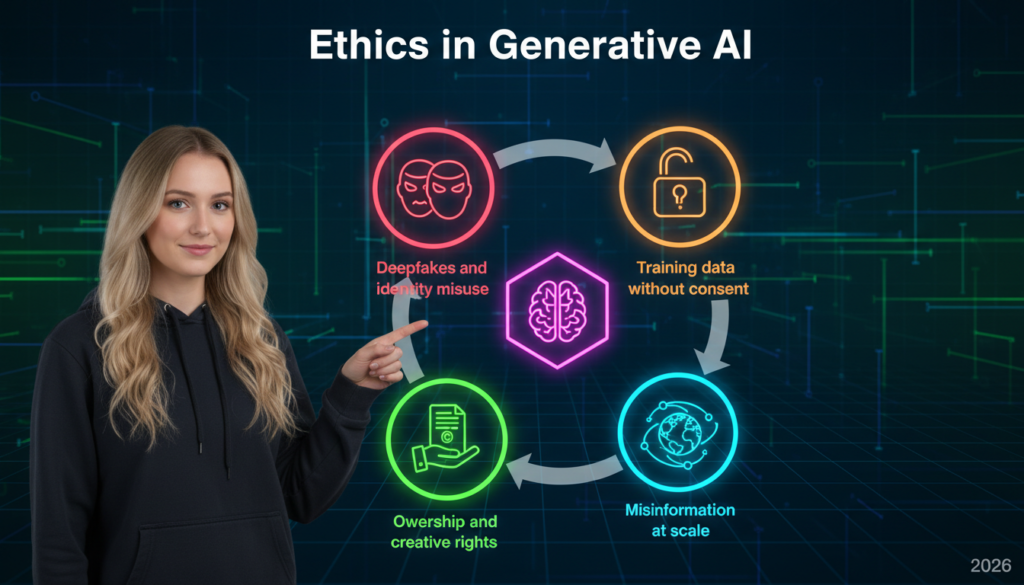
The following are the areas where the real risks sit:
Deepfakes and identity misuse
Generative AI can recreate faces, voices, and styles with alarming accuracy. Without clear labeling or safeguards, these outputs can be used for fraud, manipulation, or reputation damage. This is no longer a future problem as it’s already happening.
Training data without consent
Many models are trained on public content, creative work, and personal data without clear permission. That raises a simple ethical question: Should AI learn from work it doesn’t have the right to use?
Ownership and creative rights
Ownership of content produced by AI can often be ambiguous. If a model learned from millions of creators, who deserves credit or protection? Current laws are struggling to keep up with this reality.
Misinformation at scale
Generative AI doesn’t know the truth because it predicts patterns. That makes it easy to create convincing but false content at scale, especially during elections, crises, or public health events.
how AI technology
The most important rule: AI should never be the final authority. Humans as developers, companies, and leaders must own every output and its impact.
Generative AI is powerful, but ethics is what keeps it safe, fair, and usable in the real world.
AI Regulations and Ethics Frameworks
AI regulations differ by region, but all major frameworks aim to reduce harm, protect people, and keep humans accountable for AI systems.
As AI moves into banking, healthcare, education, and government, ethics is no longer optional. It’s becoming enforceable. Different regions are taking different paths, but the goal is the same: safe, responsible AI development.
United States: Risk Management Over Restriction
The U.S. approach focuses on guiding, not blocking innovation. The NIST AI Risk Management Framework helps organizations identify, assess, and reduce AI risks without heavy regulation.
Instead of one broad law, the U.S. uses sector-specific rules for finance, health, and employment to manage risk where it matters most. This keeps innovation fast but places responsibility on organizations to self-govern properly.
European Union: Risk-Based Law (EU AI Act)
The EU AI Act is the most structured approach so far. It classifies AI systems by risk level. High-risk uses like hiring, credit scoring, and medical tools face strict rules for transparency, data quality, human oversight, and auditing. The message is clear: the higher the risk, the higher the responsibility.
UNESCO: Human-Rights-First Ethics
UNESCO’s ethics framework takes a global view. It focuses on fairness, inclusion, privacy, and human dignity. It reminds governments and technology companies that AI must serve people, especially in developing nations where harm can scale quickly.
Government vs Private Sector Responsibility
Governments set boundaries, enforce rules, and protect public interest. Companies and developers must build ethics into design, testing, deployment, and monitoring, not as an afterthought.
The strongest AI governance happens when both sides work together: rules from the top, responsibility from the ground.
Who Is Responsible for Ethical AI? (Shared Accountability Model)
Ethical AI is not the responsibility of one group. It’s a shared duty across developers, companies, governments, and users.
One of the biggest mistakes organizations make is assuming ethics is a “developer problem.” It isn’t. Ethical AI only works when responsibility is distributed across every stage of AI development and use.
The following is an overview of how that responsibility is implemented in practice:
| Role | Responsibility |
| Technology developers | Build fairness into models, choose training data carefully, and test systems for bias before release. |
| Technology companies | Set rules for how AI is used, audit systems regularly, and stop deployment when risks appear. |
| Governments | Create regulations, define high-risk use cases, and enforce accountability when harm occurs. |
| Users | Use AI tools responsibly, question outputs, and report misuse instead of blindly trusting results. |
The above shared model matters because AI systems do not fail in isolation. Harm usually happens when one layer ignores its role. When developers ship unchecked models, companies rush deployment, or users treat AI as an authority instead of a tool.
Ethical AI works only when every layer owns its part, from design to daily use.
How to Build Ethical AI Systems
Ethical AI is built by designing for risk early, testing often, and keeping humans accountable at every stage.
Ethics cannot be added at the end of a project. It must be part of the system from day one. The strongest teams follow a simple, repeatable approach that keeps AI useful and safe.
The following steps are a practical & proven process:
1. Define ethical risk early
Before building, ask where harm could occur. Who could be affected? What decisions could the system influence? This sets the ethical boundaries for AI development.
2. Audit training data
Bias in data becomes bias in outcomes. Teams should review data sources, remove harmful patterns, and document limitations clearly.
3. Test for bias and failure modes
Run tests across different groups, edge cases, and scenarios. Ethical problems often appear in the corners, not the averages.
4. Add human approval where it matters
High-impact decisions like hiring, credit, healthcare, and legal must include human review. AI can assist, but it should not decide alone.
5. Document decisions and changes
Every model update, rule change, or override should be recorded. This creates traceability and accountability when questions arise.
6. Monitor continuously after release
Ethics doesn’t stop at launch. Real-world behavior can change models in unexpected ways, so ongoing review is essential.
Ethical AI is not slower. It’s stronger, safer, and more trusted in the long run.
Limitations of AI Ethics (What Ethics Alone Can’t Fix)
Ethics guides good behavior, but without enforcement, transparency, and regulation, ethical guidelines by themselves cannot prevent harm from real AI systems.
Most discussions about ethical AI focus on principles like fairness, accountability, privacy and rightly so. But what ethics by itself cannot do is stop harmful outcomes if the surrounding systems and rules are weak or missing.
The following are the reasons why ethical guidance alone falls short:
Ethics without enforcement fails
A set of principles that no one checks or enforces becomes a checkbox exercise. Organizations can claim ethical intent but still deploy unsafe or biased AI technology with little consequence.
Ethics without transparency fails
When developers hide how AI algorithms work, users and regulators can’t see if decisions are fair or accurate. This “black-box” problem erodes trust and lets harmful patterns slip through unnoticed.
Ethics without regulation fails
Without clear AI regulations backed by law, ethical commitments are voluntary. That means some companies choose speed over safety, increasing potential risks like biased outputs, privacy breaches, or automated decisions with real human impact.
Ethics without accountability fails
If no one is held liable when an AI system causes harm, then ethical principles become optional. Real accountability, legal and financial, is what ensures organizations take ethical obligations seriously.
In short, ethics sets the direction, but laws, oversight, and transparency are what make ethical AI real.
Future of Ethics in AI (2026-2030)
From 2026 to 2030, ethics in AI will become enforceable through audits, labeling, transparency rules, and mandatory human oversight for high-risk systems.
What will change in the next 5 years
1. Mandatory AI audits will become standard
High-risk AI systems in finance, healthcare, hiring, and government will require regular audits. These audits will test for bias, unsafe outcomes, data misuse, and decision errors, both before launch and during use.
2. AI labeling will be required by lawreal projects and teams2. AI labeling will be required by law
Users will have the right to know when content, decisions, or interactions are AI-generated. Labels for synthetic media, AI decisions, and automated systems will become as normal as privacy notices.
3. Model transparency will be enforced
Organizations will need to explain how AI systems reach decisions that affect people’s rights, money, or access to services. Black-box models will face limits in regulated sectors.
4. Human-in-the-loop will become a legal rule
AI will assist decisions, not replace them, in high-impact use cases. Final accountability will legally stay with humans, not algorithms.
5. Ethics will become a compliance standard, not a promise
By 2030, ethical AI will be measured, audited, documented, and enforced similar to financial, security, and safety compliance today.
Bottom line:
The future of ethics in AI is not about intentions. It’s about systems that prove responsibility by design, protecting innovation while keeping human intelligence in control.