
AI in crypto trading enables traders to analyze market data, manage risk, and execute trades efficiently using predefined strategies. It does not predict prices or guarantee profits. While AI responds to real-time market conditions, crypto trading remains subject to volatility, uncertainty, and financial risk.
Crypto trading is now highly dynamic, with prices changing within minutes or even seconds. For most traders, manual reactions are no longer practical.
AI addresses these challenges in crypto trading by providing consistent data analysis, timing, and risk management. This guide from Daily AI Tools experts explains how AI is applied in crypto, which strategies are effective, what risks persist, and the limitations of AI.

What Is AI in Crypto Trading?
AI in crypto trading leverages artificial intelligence to analyze market data and support trading decisions. Rather than predicting prices, AI systems study market behavior and execute trades based on learned patterns. Unlike basic bots, AI adapts to changing crypto markets in real time.
What “AI in Crypto Trading” Really Means
AI in crypto is often misunderstood. It does not identify the next high-growth coin, and future predictions are not possible. Instead, AI offers practical tools for analyzing and responding to market conditions.
AI systems look at large amounts of crypto market data:
- Price movement
- Trading volume
- Volatility
- Timing patterns
Through machine learning, AI systems identify how markets behave under specific conditions. This enables them to execute trades, manage exposure, and reduce emotional decision-making. This approach distinguishes AI from traditional crypto trading bots.
Rule-based bots:
- Follow fixed instructions
- Do the same thing every time
- Break easily in unusual market conditions
AI-driven trading systems:
- Adjust based on past outcomes
- React to real-time signals
- Handle changing market behavior better
For this reason, AI in cryptocurrency trading is most effective as a decision-support tool. It enhances speed and consistency, but strategy and risk management remain the trader’s responsibility.
How AI Works in Crypto Trading
Most trading platforms explain what their tool does, but few describe how the system operates. AI in crypto trading follows a straightforward process.
Data is received, patterns are analyzed, decisions are made, and risk rules guide the outcome. The following outlines the AI workflow in crypto trading:
Market Data AI Learns From
AI systems do not interpret charts as humans do. They process raw market signals at scale. Common inputs include:
- Price action and trading volume
- Order book depth and liquidity levels
- Volatility spikes and calm periods
- Historical market conditions across crypto markets
This data helps machine learning models understand how markets behave during different phases, rather than predicting where prices will go next.
Machine Learning Models in Trading
Once data is collected, machine learning looks for repeatable patterns. That includes:
- Recognizing setups that worked before
- Measuring how strategies perform over time
- Refining decisions as market behavior changes
The goal is not prediction, but probability assessment. AI improves how a trading strategy responds to changing conditions, rather than relying on fixed rules.
How AI Executes Trades in Real Time
When conditions match a defined setup, AI systems move fast. That process usually includes:
- Signal generation based on live data
- Entry and exit logic tied to risk limits
- Automated trading that follows predefined rules
AI can execute trades in real time, but it does not act independently. Risk management remains governed by human-defined controls.
Can AI Predict Crypto Market Movements?
AI cannot predict crypto prices with certainty. It analyzes historical data and market conditions to estimate probabilities, helping traders respond more quickly. Future results are never guaranteed.
Why Crypto Is Harder to Predict Than Stocks
Crypto markets behave differently from traditional assets.
- Lower regulation increases volatility
- News spreads faster and hits harder
- Liquidity can change within minutes
These factors make prediction unreliable, even with advanced machine learning.
The Role of Black-Swan Events
No AI system can anticipate:
- Sudden regulations
- Exchange failures
- Large wallet liquidations
- Global macro shocks
These events disrupt patterns immediately and underscore the inherent risks of cryptocurrency trading.
What AI Cannot Remove
Even the best AI-driven systems cannot eliminate:
- Market uncertainty
- Emotional decision-making outside the system
- Execution risk during extreme volatility
AI improves speed and structure but cannot eliminate risk. This reality outweighs any performance claim.
AI Trading Strategies Used in Crypto Markets Today
Most AI trading systems do not create new strategies. They apply established methods more consistently and at a scale beyond human capability. These strategies are data-driven, not based on promises.
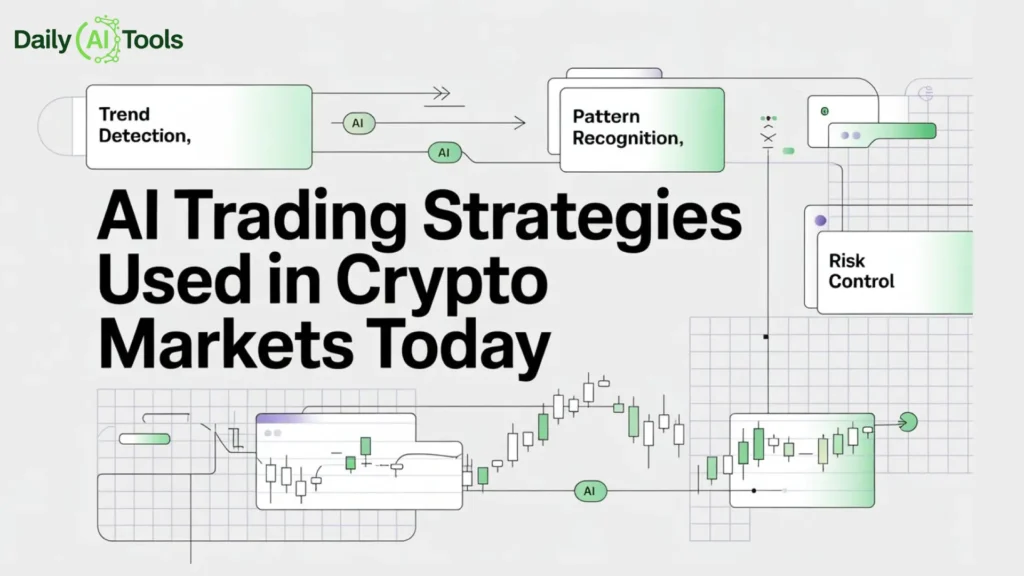
The following are the most commonly used strategy-based approaches in crypto markets today:
Trend-Following Strategies
Trend-following focuses on aligning with market momentum rather than timing market tops or bottoms.
AI helps by:
- Identifying sustained price direction
- Filtering short-term noise in volatile markets
- Avoiding emotional exits during pullbacks
This strategy is most effective when markets move in a clear direction and liquidity remains stable.
Arbitrage & Inefficiency Detection
Crypto markets are fragmented, and prices often differ across exchanges. AI systems scan for:
- Price gaps between trading platforms
- Liquidity mismatches
- Short-lived inefficiencies
The primary advantage is speed. AI reacts faster than humans, but margins are small and competition is intense.
Mean Reversion Strategies
Mean reversion assumes prices often correct after extreme movements. AI identifies:
- Overbought and oversold conditions
- Short-term deviations from recent averages
- Quick correction opportunities
This strategy requires strict risk management, especially during strong trends when reversals may not occur.
Risk-Managed Portfolio Strategies
Some AI systems prioritize exposure control over individual trades. This includes:
- Position sizing based on volatility
- Balancing risk across multiple assets
- Reducing drawdowns during unstable periods
In this context, AI supports discipline by prioritizing downside protection over chasing gains.
AI Crypto Trading Bots Explained (What They Do vs What They Don’t)
Crypto trading bots are often misunderstood. They automate execution rather than intelligence. Their value depends on design and ongoing monitoring.
What AI Crypto Trading Bots Handle Well
AI crypto trading bots perform best at structured, repeatable tasks. They handle:
- Continuous market monitoring without fatigue
- Rule-based execution without emotion
- Tracking multiple pairs on the same trading platform
For traders managing large volumes, consistency is more important than speed alone.
What Bots Cannot Do Reliably
Bots have clear limitations. They cannot:
- Understand the news context or political risk
- Anticipate regulatory shocks
- Replace human judgment during abnormal events
An AI crypto trading bot follows logic but does not interpret meaning. Understanding this distinction is essential for responsible automation.
Best AI Crypto Trading Tools
The following tools are widely used in cryptocurrency trading, but each fits a different type of trader. Performance depends on setup, strategy control, and market conditions:
Cryptohopper
Best for traders seeking strategy control with automation. Cryptohopper supports AI-assisted signals, rule-based logic, and marketplace strategies. It is commonly used for trend and portfolio strategies, offering flexible risk management and strong exchange API access.
Stoic by Cindicator
Designed for hands-off portfolio rebalancing, Stoic uses AI-driven allocation models instead of frequent trades. It suits long-term traders who prefer exposure management over active execution, though strategy transparency is limited.
Algoritmic Trading (3Commas AI)
Known for execution and risk tools, not prediction. Its AI features support smart trade setups, dynamic take-profit logic, and automated trading across pairs. It is popular with users who already understand their trading strategy.
Pionex
Best for built-in bots with low setup effort, Pionex offers AI-based grid and rebalancing bots directly on the trading platform. Customization is limited, but it is suitable for beginners testing automated trading in real time.
Coinrule
Focused on logic-based strategies with AI assistance, Coinrule helps users build rules without coding and optimizes execution using machine learning insights. It works well for disciplined strategies rather than aggressive speculation.
Popular AI Crypto Trading Platforms (What Users Should Know Before Trying)
Instead of seeking the “best” platform, users should evaluate fit and control. Most losses result from misuse, not the tools themselves. Before using any AI trading platform, consider the following:
Strategy control level
Can you adjust logic, risk limits, and exits, or is it locked?
Risk customization
Does the platform allow position sizing, stop logic, and exposure limits?
Transparency of models
Are decisions explainable, or completely opaque?
Custody and API access
Does the platform trade via API, or hold funds directly?
Platforms differ more in control and risk handling than in intelligence. This is where informed users gain an advantage.
Risk Management in AI-Driven Crypto Trading
AI improves execution speed but does not ensure safety. Risk management remains the deciding factor between controlled losses and account damage.
Market Risks AI Cannot Remove
Some risks exist regardless of intelligence. These include:
- Flash crashes that bypass stop logic
- Low-liquidity traps where exits fail
- Sudden volatility shifts during thin markets
AI reacts to market conditions but cannot prevent them.
Strategy Risks
Even well-designed systems fail when assumptions break. Common strategy risks:
- Overfitting to past data that no longer reflects reality
- Strategy decay as market behavior changes
- Delayed response during regime shifts
Without regular review, automated systems may gradually incur losses.
Platform & Execution Risks
Technical layers introduce their own threats. These include:
- API failures during high volatility
- Slippage between signal and execution
- Exchange downtime during peak activity
These inherent risks make monitoring essential, even with automated trading enabled.
Is AI Crypto Trading Legal and Safe?
AI in crypto trading is legal in most regions, but rules depend on your location and how the tool is used. Here’s what matters:
AI crypto trading is not illegal by default
AI is treated as a trading tool, not a loophole or workaround.
Legality depends on jurisdiction
Some countries regulate automated trading more strictly than others, especially when it involves leverage or custodial platforms.
Responsibility stays with the trader
Even when trades are AI-driven, the account holder is responsible for compliance, taxes, and risk.
AI does not remove legal obligations. It only helps execute decisions faster within existing rules.
Can You Trust AI Trading Systems?
Only when users understand their limits. Common trust issues include:
- Limited transparency around how decisions are made
- Over-automation without human review
- Blind reliance on preset strategies
Where AI helps:
- Faster execution
- Consistent rule-following
- Reduced emotional trading
Key takeaway:
AI improves speed and discipline, but humans must still control strategy, risk, and capital allocation.
Can AI Make You Consistent Profits in Crypto?
Expectations are important. No AI system can guarantee profits in cryptocurrency trading. Markets change, liquidity shifts, and unexpected events can break models.
What often goes wrong:
- Marketing exaggerates future results
- Short-term wins are mistaken for reliability
- Loss periods are hidden or ignored
Reality check:
- There is no “$1,000 per day” AI system
- Short-term gains don’t equal long-term consistency
- Capital protection matters more than win rate
AI can support decision-making, but it cannot eliminate uncertainty.
Who AI in Crypto Trading Is Best For (and Who It Isn’t)
AI works best when paired with understanding, not hope.
Best Fit For:
- Data-driven traders who test strategies
- Portfolio managers balancing exposure
- Users focused on discipline and risk control
Not Ideal For:
- Passive investors seeking hands-free income
- Emotion-driven traders avoid responsibility
- Anyone expecting guaranteed profits
AI rewards structure, not shortcuts.
The Future of AI in Crypto Trading
The next phase of AI in crypto trading will be more practical, not more aggressive.
What’s coming:
- Better real-time risk modeling
- Hybrid human-AI strategies instead of full automation
- Fewer black-box bots and more explainable systems
AI-driven tools will likely focus less on prediction and more on risk awareness, execution quality, and capital protection.
Future results will favor traders who understand both the technology and the market, not those who rely on automation alone.
Daily AI Tools Verdict
AI helps traders execute faster, stay consistent, and manage complexity in fast-moving crypto markets. It does not replace strategy, discipline, or judgment. Smart use of AI supports better decisions, but risk never disappears. Long-term results come from combining AI-driven execution with human control, clear rules, and realistic expectations. For more software options, explore our best AI tools in 2026 list.