
Artificial intelligence is no longer an emerging concept. It’s already shaping how we work, shop, travel, and make decisions every day. From fraud detection in banking to predictive maintenance in factories, AI-driven systems are already making decisions at scale.
What’s driving this shift isn’t just more innovative software. It’s the massive growth of data, faster computing power, and self-learning algorithms that improve with use. As global data creation continues to rise year after year, AI has moved from experimental labs into real-world systems.
In this article, you will learn what AI is in technology, how it works behind the scenes, and why its impact across industries is accelerating faster than ever.
What Is AI in Technology?
AI in technology refers to computer systems that simulate human intelligence to analyze data, learn patterns, and make decisions without constant human input.
Unlike traditional software that follows fixed rules, AI systems improve over time. They analyze large volumes of data, identify relationships, and adapt their behavior based on outcomes. This ability to learn and adjust is what separates artificial intelligence from standard automation.
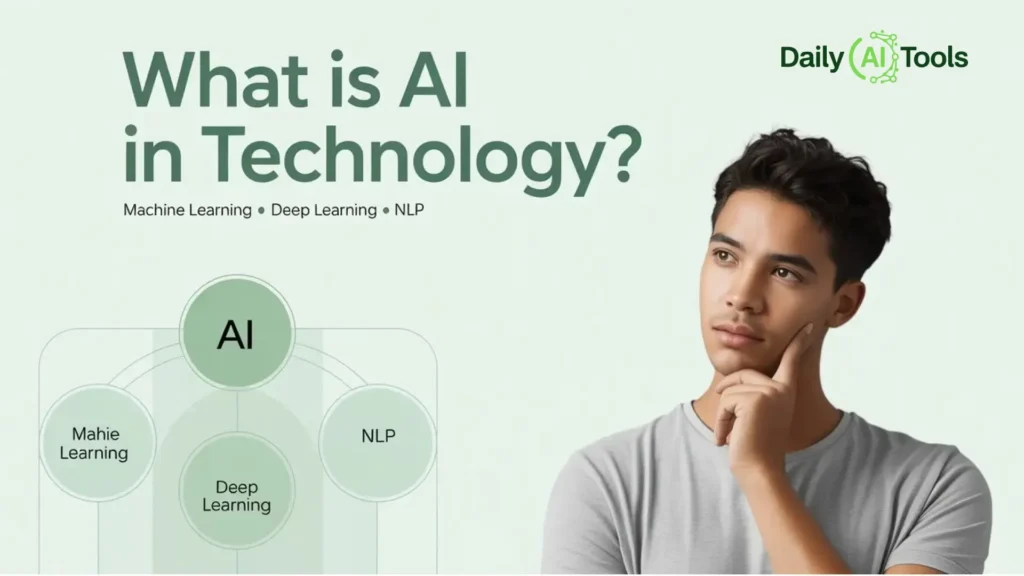
At the core of modern AI are three foundational technologies:
- Machine Learning (ML): Algorithms that learn from data without being explicitly programmed, often used for predictions and pattern recognition.
- Deep Learning: A subset of ML that uses neural networks to process complex data like images, video, and speech.
- Natural Language Processing (NLP): Enables machines to understand, interpret, and respond to human language in a meaningful way.
Together, these technologies allow AI systems to power everything. You will have recommendation engines and voice assistants with fraud detection and medical imaging tools.
Why AI Adoption Is Accelerating Now
AI has existed for decades, but its real-world adoption has surged in recent years. The main reason is scale. Today’s systems have access to more data, faster processors, and cloud infrastructure. They are capable of training models at speeds that were impossible even a decade ago.
Recent industry reports show that companies using AI-driven systems experience measurable gains in operational efficiency and decision accuracy.
AI is no longer a competitive advantage reserved for large enterprises. It’s becoming a baseline expectation across industries. This shift explains why AI is now embedded in everyday technology rather than treated as a standalone feature.
Industries Being Transformed by AI
AI is not confined to a single sector. Its influence is spreading wherever data, decisions, and automation intersect. The following industries have absorbed the AI-powered systems already:
Healthcare
In healthcare, AI supports faster and more accurate diagnoses by analyzing medical images, lab results, and patient histories. Machine learning models assist clinicians in detecting conditions earlier, prioritizing urgent cases, and reducing diagnostic errors. Explore the latest AI Lifestyle and Health tools here.
AI is also accelerating drug discovery by identifying potential compounds and predicting treatment outcomes, helping researchers move faster while lowering development costs.
Finance
Financial institutions use AI to detect fraud, assess risk, and automate decision-making processes that once required manual review. Real-time transaction monitoring helps identify suspicious activity instantly, while predictive models assist with credit evaluation and investment analysis.
For consumers and small businesses, AI-powered financial tools are making advanced insights more accessible without relying solely on human advisors. Find specialized AI Business solutions for finance.
Manufacturing
In manufacturing, AI-driven systems improve efficiency through predictive maintenance, quality control, and production optimization. By analyzing sensor data and equipment performance, AI can identify potential failures before they disrupt operations.
When combined with robotics and IoT systems, AI enables smart factories that adapt in real time, reducing waste while improving output consistency.
Why Understanding AI Matters
AI in technology is no longer optional knowledge. As systems become more autonomous and integrated into daily tools, understanding how AI works and where its limitations lie becomes essential.
The most effective outcomes happen when human judgment and AI intelligence work together. Knowing when to rely on automation and when to apply human oversight is what separates effective use from blind dependence.
In the next section, we’ll explore how AI is redefining innovation. Things like autonomous systems to intelligent software, and what that means for the future of technology.
AI Innovations Redefining Modern Technology
Artificial intelligence is changing what technology is capable of doing. Many innovations that once felt experimental are now operating at scale, reshaping how people move, communicate, and build software.
What makes these innovations powerful is not novelty, but reliability. AI systems are now accurate enough to be trusted in environments where errors were once unacceptable.
Autonomous Systems
Autonomous systems are one of the clearest examples of AI in action. Self-driving technologies use computer vision, sensor fusion, and real-time decision models to interpret surroundings and respond faster than human reflexes.
Companies working on autonomous vehicles have demonstrated how AI can reduce reaction time, improve navigation accuracy, and handle complex environments like traffic intersections.
Beyond cars, autonomous drones are already being used for deliveries, mapping, agriculture, and infrastructure inspection.
These systems don’t replace human judgment. They reduce human overload by handling repetitive, high-speed decision-making where consistency matters most.
Smart Devices and the Internet of Things (IoT)
AI-powered smart devices have changed how people interact with technology at home and at work. From thermostats that learn daily routines to security systems that distinguish between real threats and background movement, AI allows devices to adapt instead of react.
When combined with IoT, AI enables systems to communicate and adjust in real time. Intelligent energy management, predictive maintenance in buildings, and intelligent traffic systems all rely on AI-driven analysis rather than manual control.
The value here isn’t convenience alone. It’s efficiency, safety, and better use of resources.
AI in Software Development
AI has also reshaped software development. Developers now use AI-assisted tools to analyze code, suggest improvements, detect bugs, and speed up repetitive tasks.
AI does not replace developers so far, but it removes friction. By handling routine analysis and pattern recognition, AI allows engineers to focus on architecture, logic, and problem-solving. This has led to faster development cycles, fewer errors, and more maintainable codebases.
Tools powered by AI are handy in large projects where manual review alone would slow progress or miss hidden issues.
Ethical Challenges and Real-World Concerns
As AI becomes more deeply embedded in technology, it also introduces challenges that cannot be ignored. Data privacy, algorithmic bias, and transparency remain ongoing concerns.
AI systems learn from data, and biased or incomplete data can lead to unfair or inaccurate outcomes. This makes responsible data handling, testing, and oversight essential, especially in sensitive fields like healthcare, finance, and public services.
Another concern is workforce impact. While AI automates repetitive tasks, it also shifts skill requirements. The focus is moving toward collaboration with intelligent systems rather than direct replacement.
Responsible AI development depends on regulation, accountability, and human supervision, not unchecked automation.
The Future of AI in Technology
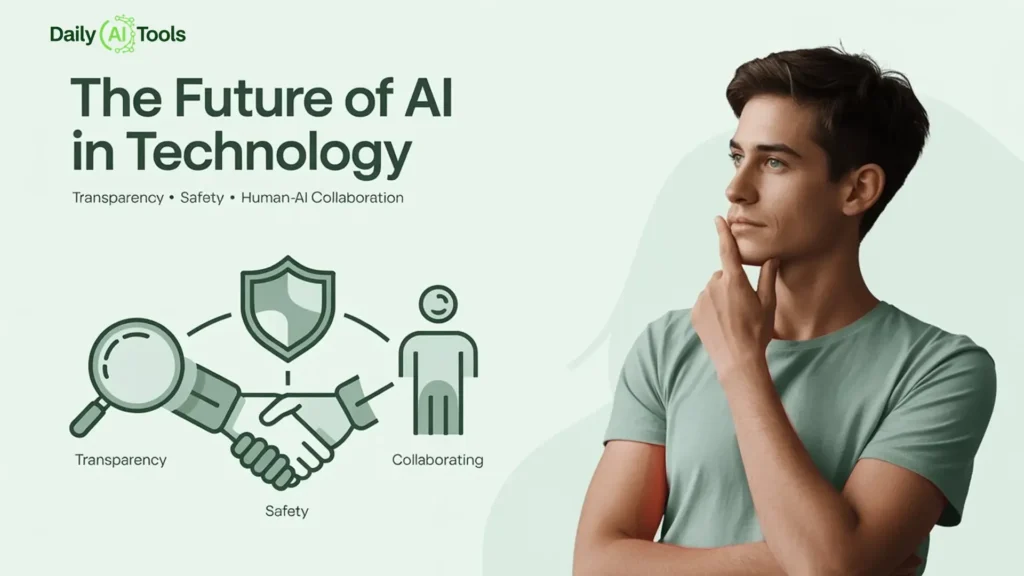
The next phase of AI development is not about making systems more complex, but more trustworthy. Explainable AI, better governance frameworks, and energy-efficient models are becoming priorities as adoption grows.
Future AI systems will focus on:
- Transparency in decision-making
- Safer integration into critical infrastructure
- Human-AI collaboration rather than autonomy alone
AI will continue to shape technology, but its success will depend on how responsibly it is designed and used.
Conclusion
AI in technology is not a trend. It’s a structural shift in how systems are built and operated. From healthcare and manufacturing to software and smart devices, AI is redefining efficiency, accuracy, and scalability.
Understanding AI helps individuals and businesses use it effectively rather than blindly. When paired with human judgment, AI becomes a tool for progress instead of a source of uncertainty.
As AI continues to evolve, the real advantage will belong to those who understand how to use it responsibly. AI may power technology, but progress depends on human judgment. If you are looking to implement these technologies today, check out our AI Tool Directory where we have reviewed over 1,000 tools including AI Video Generators and AI Image Tools.